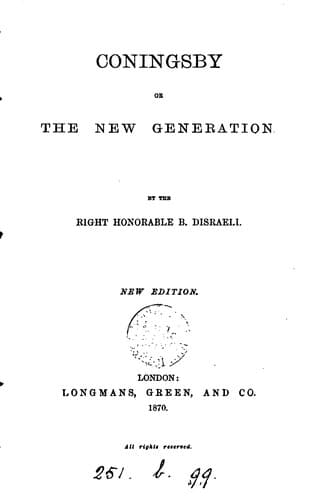
Coningsby; Or, The New GenerationDisraeli, Benjamin, Earl of Beaconsfield
General
Coningsby; Or, The New Generation
Disraeli, Benjamin, Earl of Beaconsfield
Great Britain -- Fiction; Political fiction; Politicians -- Fiction
Rigby had as yet one great advantage; he had no opponent; and without
personal opposition, no contest can be very bitter. It was for some days
Rigby _versus_ Liberal principles; and Rigby had much the best of it;
for he abused Liberal principles roundly in his harangues, who, not
being represented on the occasion, made no reply; while plenty of ale,
and some capital songs by Lucian Gay, who went down express, gave the
right cue to the mob, who declared in chorus, beneath the windows of
Rigby’s hotel, that he was ‘a fine old English gentleman!’
But there was to be a contest; no question about that, and a sharp
one, although Rigby was to win, and well. The Liberal party had been so
fastidious about their new candidate, that they had none ready though
several biting. Jawster Sharp thought at one time that sheer necessity
would give him another chance still; but even Rigby was preferable to
Jawster Sharp, who, finding it would not do, published his long-prepared
valedictory address, in which he told his constituents, that having long
sacrificed his health to their interests, he was now obliged to retire
into the bosom of his family. And a very well-provided-for family, too.
All this time the Liberal deputation from Darlford, two aldermen, three
town-councillors, and the Secretary of the Reform Association, were
walking about London like mad things, eating luncheons and looking for
a candidate. They called at the Reform Club twenty times in the morning,
badgered whips and red-tapers; were introduced to candidates, badgered
candidates; examined would-be members as if they were at a cattle-show,
listened to political pedigrees, dictated political pledges, referred
to Hansard to see how men had voted, inquired whether men had spoken,
finally discussed terms. But they never could hit the right man. If
the principles were right, there was no money; and if money were ready,
money would not take pledges. In fact, they wanted a Phoenix: a very
rich man, who would do exactly as they liked, with extremely low
opinions and with very high connections.
‘If he would go for the ballot and had a handle to his name, it would
have the best effect,’ said the secretary of the Reform Association,
‘because you see we are fighting against a Right Honourable, and you
have no idea how that takes with the mob.’
Public-domain text, read in full here on John Shaqi.
Reviews
Reviews
No reviews yet
Be the first to share your thoughts on this work.
Elsewhere in the archive
Join the Discussion
Join the discussion
Sign in to leave a comment or review.
Sign InorCreate an account