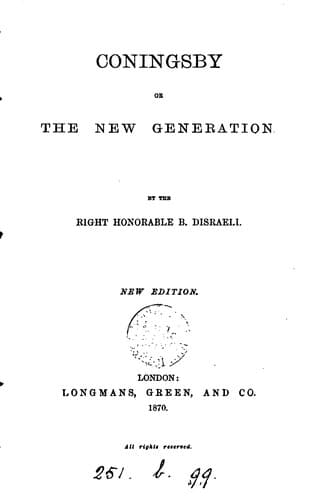
Coningsby; Or, The New GenerationDisraeli, Benjamin, Earl of Beaconsfield
General
Coningsby; Or, The New Generation
Disraeli, Benjamin, Earl of Beaconsfield
Great Britain -- Fiction; Political fiction; Politicians -- Fiction
‘Gentlemen,’ said the groom of the chambers, in a loud voice, entering
the room, ‘I am desired to state that the Duke of Wellington is with the
King.’
‘There _is_ a Providence!’ exclaimed an agitated gentleman, the patent
of whose intended peerage had not been signed the day that the Duke had
quited office in 1830.
‘I always thought the King would be firm,’ said Mr. Tadpole.
‘I wonder who will have the India Board,’ said Taper.
At this moment three or four gentlemen entered the room in a state of
great bustle and excitement; they were immediately surrounded.
‘Is it true?’ ‘Quite true; not the slightest doubt. Saw him myself. Not
at all hissed; certainly not hooted. Perhaps a little hissed. One
fellow really cheered him. Saw him myself. Say what they like, there is
reaction.’ ‘But Constitution Hill, they say?’ ‘Well, there was a sort
of inclination to a row on Constitution Hill; but the Duke quite firm;
pistols, and carriage doors bolted.’
Such may give a faint idea of the anxious inquiries and the satisfactory
replies that were occasioned by the entrance of this group.
‘Up, guards, and at them!’ exclaimed Tadpole, rubbing his hands in a fit
of patriotic enthusiasm.
Later in the afternoon, about five o’clock, the high change of political
gossip, when the room was crowded, and every one had his rumour, Mr.
Rigby looked in again to throw his eye over the evening papers, and
catch in various chit-chat the tone of public or party feeling on the
‘crisis.’ Then it was known that the Duke had returned from the
King, having accepted the charge of forming an administration. An
administration to do what? Portentous question! Were concessions to
be made? And if so, what? Was it altogether impossible, and too late,
‘stare super vias antiquas?’ Questions altogether above your Tadpoles
and your Tapers, whose idea of the necessities of the age was that they
themselves should be in office.
Lord Eskdale came up to Mr. Rigby. This peer was a noble Croesus,
acquainted with all the gradations of life; a voluptuary who could be a
Spartan; clear-sighted, unprejudiced, sagacious; the best judge in the
world of a horse or a man; he was the universal referee; a quarrel about
a bet or a mistress was solved by him in a moment, and in a manner which
satisfied both parties. He patronised and appreciated the fine arts,
though a jockey; respected literary men, though he only read French
novels; and without any affectation of tastes which he did not possess,
was looked upon by every singer and dancer in Europe as their natural
champion. The secret of his strong character and great influence was his
self-composure, which an earthquake or a Reform Bill could not disturb,
and which in him was the result of temperament and experience. He was
an intimate acquaintance of Lord Monmouth, for they had many tastes
in common; were both men of considerable, and in some degree similar
abilities; and were the two greatest proprietors of close boroughs in
the country.
Public-domain text, read in full here on John Shaqi.
Reviews
Reviews
No reviews yet
Be the first to share your thoughts on this work.
Join the Discussion
Join the discussion
Sign in to leave a comment or review.
Sign InorCreate an account