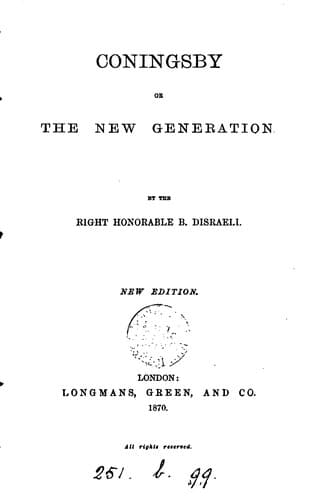
Coningsby; Or, The New GenerationDisraeli, Benjamin, Earl of Beaconsfield
General
Coningsby; Or, The New Generation
Disraeli, Benjamin, Earl of Beaconsfield
Great Britain -- Fiction; Political fiction; Politicians -- Fiction
The secretary returned with a young gentleman, whose diminutive stature
would seem, from his smooth and singularly puerile countenance, to be
merely the consequence of his very tender years; but Mr. De Crecy was
really of age, or at least would be by nomination-day. He did not say
a word, but looked like the rosebud which dangled in the button-hole of
his frock-coat. The aldermen and town-councillors were what is
sometimes emphatically styled flabbergasted; they were speechless from
bewilderment. ‘Mr. De Crecy will go for the ballot,’ said the secretary
of the Treasury, with an audacious eye and a demure look, ‘and for Total
and Immediate, if you press him hard; but don’t, if you can help it,
because he has an uncle, an old county member, who has prejudices, and
might disinherit him. However, we answer for him. And I am very happy
that I have been the means of bringing about an arrangement which,
I feel, will be mutually advantageous.’ And so saying, the secretary
effected his escape.
Circumstances, however, retarded for a season the political career of
the Honourable Alberic de Crecy. While the Liberal party at Darlford
were suffering under the daily inflictions of Mr. Rigby’s slashing
style, and the post brought them very unsatisfactory prospects of a
champion, one offered himself, and in an address which intimated that he
was no man of straw, likely to recede from any contest in which he
chose to embark. The town was suddenly placarded with a letter to
the Independent Electors from Mr. Millbank, the new proprietor of
Hellingsley.
He expressed himself as one not anxious to obtrude himself on their
attention, and founding no claim to their confidence on his recent
acquisition; but at the same time as one resolved that the free and
enlightened community, with which he must necessarily hereafter be much
connected, should not become the nomination borough of any Peer of the
realm without a struggle, if they chose to make one. And so he offered
himself if they could not find a better candidate, without waiting for
the ceremony of a requisition. He was exactly the man they wanted; and
though he had ‘no handle to his name,’ and was somewhat impracticable
about pledges, his fortune was so great, and his character so high, that
it might be hoped that the people would be almost as content as if
they were appealed to by some obscure scion of factitious nobility,
subscribing to political engagements which he could not comprehend,
and which, in general, are vomited with as much facility as they are
swallowed.
CHAPTER IV.
Public-domain text, read in full here on John Shaqi.
Reviews
Reviews
No reviews yet
Be the first to share your thoughts on this work.
Elsewhere in the archive
Join the Discussion
Join the discussion
Sign in to leave a comment or review.
Sign InorCreate an account