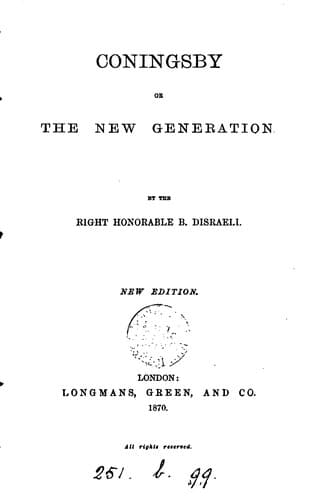
Coningsby; Or, The New GenerationDisraeli, Benjamin, Earl of Beaconsfield
General
Coningsby; Or, The New Generation
Disraeli, Benjamin, Earl of Beaconsfield
Great Britain -- Fiction; Political fiction; Politicians -- Fiction
The people of Darlford, who, as long as the contest for their
representation remained between Mr. Rigby and the abstraction called
Liberal Principles, appeared to be very indifferent about the result,
the moment they learned that for the phrase had been substituted a
substance, and that, too, in the form of a gentleman who was soon
to figure as their resident neighbour, became excited, speedily
enthusiastic. All the bells of all the churches rang when Mr. Millbank
commenced his canvass; the Conservatives, on the alert, if not alarmed,
insisted on their champion also showing himself in all directions; and
in the course of four-and-twenty hours, such is the contagion of popular
feeling, the town was divided into two parties, the vast majority of
which were firmly convinced that the country could only be saved by the
return of Mr. Rigby, or preserved from inevitable destruction by the
election of Mr. Millbank.
The results of the two canvasses were such as had been anticipated from
the previous reports of the respective agents and supporters. In these
days the personal canvass of a candidate is a mere form. The whole
country that is to be invaded has been surveyed and mapped out before
entry; every position reconnoitred; the chain of communications
complete. In the present case, as was not unusual, both candidates were
really supported by numerous and reputable adherents; and both had good
grounds for believing that they would be ultimately successful. But
there was a body of the electors sufficiently numerous to turn the
election, who would not promise their votes: conscientious men who felt
the responsibility of the duty that the constitution had entrusted to
their discharge, and who would not make up their minds without duly
weighing the respective merits of the two rivals. This class of deeply
meditative individuals are distinguished not only by their pensive turn
of mind, but by a charitable vein that seems to pervade their being. Not
only will they think of your request, but for their parts they wish both
sides equally well. Decision, indeed, as it must dash the hopes of one
of their solicitors, seems infinitely painful to them; they have always
a good reason for postponing it. If you seek their suffrage during the
canvass, they reply, that the writ not having come down, the day of
election is not yet fixed. If you call again to inform them that the
writ has arrived, they rejoin, that perhaps after all there may not be a
contest. If you call a third time, half dead with fatigue, to give them
friendly notice that both you and your rival have pledged yourselves to
go to the poll, they twitch their trousers, rub their hands, and with a
dull grin observe,
‘Well, sir, we shall see.’
‘Come, Mr. Jobson,’ says one of the committee, with an insinuating
smile, ‘give Mr. Millbank one.’
‘Jobson, I think you and I know each other,’ says a most influential
supporter, with a knowing nod.
‘Yes, Mr. Smith, I should think we did.’
Public-domain text, read in full here on John Shaqi.
Reviews
Reviews
No reviews yet
Be the first to share your thoughts on this work.
Elsewhere in the archive
Join the Discussion
Join the discussion
Sign in to leave a comment or review.
Sign InorCreate an account