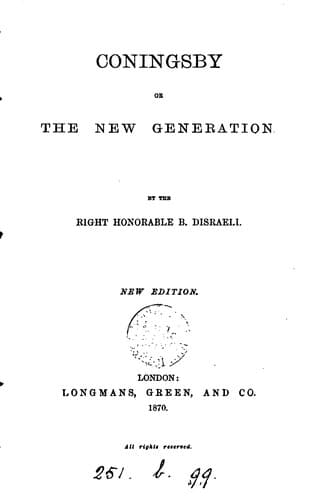
Coningsby; Or, The New GenerationDisraeli, Benjamin, Earl of Beaconsfield
General
Coningsby; Or, The New Generation
Disraeli, Benjamin, Earl of Beaconsfield
Great Britain -- Fiction; Political fiction; Politicians -- Fiction
‘Come, come, give us one.’
‘Well, I have not made up my mind yet, gentlemen.’
‘Jobson!’ says a solemn voice, ‘didn’t you tell me the other night you
wished well to this gentleman?’
‘So I do; I wish well to everybody,’ replies the imperturbable Jobson.
‘Well, Jobson,’ exclaims another member of the committee, with a sigh,
‘who could have supposed that you would have been an enemy?’
‘I don’t wish to be no enemy to no man, Mr. Trip.’
‘Come, Jobson,’ says a jolly tanner, ‘if I wanted to be a Parliament
man, I don’t think you could refuse me one!’
‘I don’t think I could, Mr. Oakfield.’
‘Well, then, give it to my friend.’
‘Well, sir, I’ll think about it.’
‘Leave him to me,’ says another member of the committee, with a
significant look. ‘I know how to get round him. It’s all right.’
‘Yes, leave him to Hayfield, Mr. Millbank; he knows how to manage him.’
But all the same, Jobson continues to look as little tractable and
lamb-like as can be well fancied.
And here, in a work which, in an unpretending shape, aspires to take
neither an uninformed nor a partial view of the political history of the
ten eventful years of the Reform struggle, we should pause for a
moment to observe the strangeness, that only five years after the
reconstruction of the electoral body by the Whig party, in a borough
called into political existence by their policy, a manufacturing
town, too, the candidate comprising in his person every quality and
circumstance which could recommend him to the constituency, and
his opponent the worst specimen of the Old Generation, a political
adventurer, who owed the least disreputable part of his notoriety to
his opposition to the Reform Bill; that in such a borough, under such
circumstances, there should be a contest, and that, too, one of a very
doubtful issue.
What was the cause of this? Are we to seek it in the ‘Reaction’ of the
Tadpoles and the Tapers? That would not be a satisfactory solution.
Reaction, to a certain extent, is the law of human existence. In the
particular state of affairs before us, England after the Reform Act, it
never could be doubtful that Time would gradually, and in some instances
rapidly, counteract the national impulse of 1832. There never could
have been a question, for example, that the English counties would
have reverted to their natural allegiance to their proprietors; but the
results of the appeals to the third Estate in 1835 and 1837 are not to
be accounted for by a mere readjustment of legitimate influences.
The truth is, that, considerable as are the abilities of the Whig
leaders, highly accomplished as many of them unquestionably must be
acknowledged in parliamentary debate, experienced in council, sedulous
in office, eminent as scholars, powerful from their position, the
absence of individual influence, and of the pervading authority of a
commanding mind, have been the cause of the fall of the Whig party.
Public-domain text, read in full here on John Shaqi.
Reviews
Reviews
No reviews yet
Be the first to share your thoughts on this work.
Elsewhere in the archive
Join the Discussion
Join the discussion
Sign in to leave a comment or review.
Sign InorCreate an account