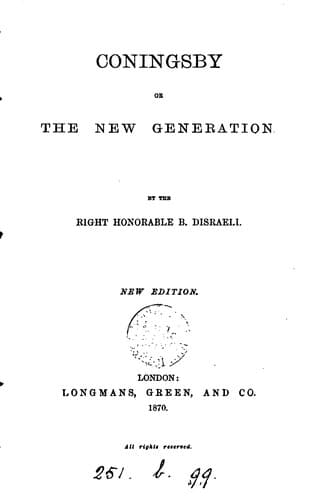
Coningsby; Or, The New GenerationDisraeli, Benjamin, Earl of Beaconsfield
General
Coningsby; Or, The New Generation
Disraeli, Benjamin, Earl of Beaconsfield
Great Britain -- Fiction; Political fiction; Politicians -- Fiction
The departure of Sidonia from Coningsby Castle, in the autumn,
determined the Princess Lucretia on a step which had for some time
before his arrival occupied her brooding imagination. Nature had
bestowed on this lady an ambitious soul and a subtle spirit; she could
dare much and could execute finely. Above all things she coveted power;
and though not free from the characteristic susceptibility of her sex,
the qualities that could engage her passions or fascinate her fancy must
partake of that intellectual eminence which distinguished her. Though
the Princess Lucretia in a short space of time had seen much of the
world, she had as yet encountered no hero. In the admirers whom her
rank, and sometimes her intelligence, assembled around her, her master
had not yet appeared. Her heart had not trembled before any of those
brilliant forms whom she was told her sex admired; nor did she envy any
one the homage which she did not appreciate. There was, therefore, no
disturbing element in the worldly calculations which she applied to that
question which is, to woman, what a career is to man, the question of
marriage. She would marry to gain power, and therefore she wished to
marry the powerful. Lord Eskdale hovered around her, and she liked
him. She admired his incomparable shrewdness; his freedom from ordinary
prejudices; his selfishness which was always good-natured, and the
imperturbability that was not callous. But Lord Eskdale had hovered
round many; it was his easy habit. He liked clever women, young, but who
had seen something of the world. The Princess Lucretia pleased him much;
with the form and mind of a woman even in the nursery. He had watched
her development with interest; and had witnessed her launch in that
world where she floated at once with as much dignity and consciousness
of superior power, as if she had braved for seasons its waves and its
tempests.
Musing over Lord Eskdale, the mind of Lucretia was drawn to the image
of his friend; her friend; the friend of her parents. And why not marry
Lord Monmouth? The idea pleased her. There was something great in the
conception; difficult and strange. The result, if achieved, would give
her all that she desired. She devoted her mind to this secret thought.
She had no confidants. She concentrated her intellect on one point,
and that was to fascinate the grandfather of Coningsby, while her
step-mother was plotting that she should marry his grandson. The
volition of Lucretia Colonna was, if not supreme, of a power most
difficult to resist. There was something charm-like and alluring in the
conversation of one who was silent to all others; something in the tones
of her low rich voice which acted singularly on the nervous system. It
was the voice of the serpent; indeed, there was an undulating movement
in Lucretia, when she approached you, which irresistibly reminded you of
that mysterious animal.
Public-domain text, read in full here on John Shaqi.
Reviews
Reviews
No reviews yet
Be the first to share your thoughts on this work.
Elsewhere in the archive
Join the Discussion
Join the discussion
Sign in to leave a comment or review.
Sign InorCreate an account