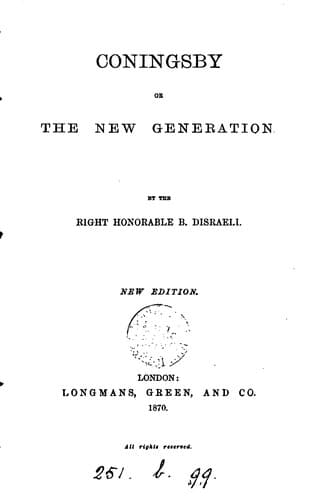
Coningsby; Or, The New GenerationDisraeli, Benjamin, Earl of Beaconsfield
General
Coningsby; Or, The New Generation
Disraeli, Benjamin, Earl of Beaconsfield
Great Britain -- Fiction; Political fiction; Politicians -- Fiction
Lord Monmouth was not insensible to the spell, though totally
unconscious of its purpose. He found the society of Lucretia very
agreeable to him; she was animated, intelligent, original; her inquiries
were stimulating; her comments on what she saw, and heard, and read,
racy and often indicating a fine humour. But all this was reserved for
his ear. Before her parents, as before all others, Lucretia was silent,
a little scornful, never communicating, neither giving nor seeking
amusement, shut up in herself.
Lord Monmouth fell therefore into the habit of riding and driving with
Lucretia alone. It was an arrangement which he found made his life more
pleasant. Nor was it displeasing to Madame Colonna. She looked upon
Lord Monmouth’s fancy for Lucretia as a fresh tie for them all. Even the
Prince, when his wife called his attention to the circumstance, observed
it with satisfaction. It was a circumstance which represented in his
mind a continuance of good eating and good drinking, fine horses,
luxurious baths, unceasing billiards.
In this state of affairs appeared Sidonia, known before to her
step-mother, but seen by Lucretia for the first time. Truly, he came,
saw, and conquered. Those eyes that rarely met another’s were fixed upon
his searching yet unimpassioned glance. She listened to that voice,
full of music yet void of tenderness; and the spirit of Lucretia Colonna
bowed before an intelligence that commanded sympathy, yet offered none.
Lucretia naturally possessed great qualities as well as great talents.
Under a genial influence, her education might have formed a being
capable of imparting and receiving happiness. But she found herself
without a guide. Her father offered her no love; her step-mother gained
from her no respect. Her literary education was the result of her
own strong mind and inquisitive spirit. She valued knowledge, and she
therefore acquired it. But not a single moral principle or a single
religious truth had ever been instilled into her being. Frequent
absence from her own country had by degrees broken off even an habitual
observance of the forms of her creed; while a life of undisturbed
indulgence, void of all anxiety and care, while it preserved her from
many of the temptations to vice, deprived her of that wisdom ‘more
precious than rubies,’ which adversity and affliction, the struggles and
the sorrows of existence, can alone impart.
Public-domain text, read in full here on John Shaqi.
Reviews
Reviews
No reviews yet
Be the first to share your thoughts on this work.
Elsewhere in the archive
Join the Discussion
Join the discussion
Sign in to leave a comment or review.
Sign InorCreate an account