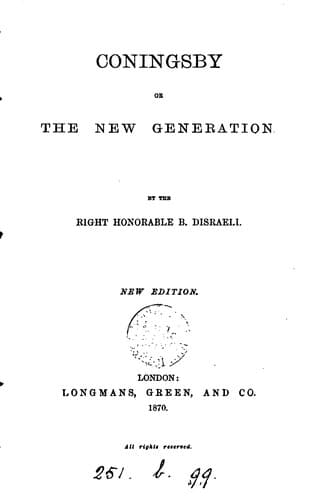
Coningsby; Or, The New GenerationDisraeli, Benjamin, Earl of Beaconsfield
General
Coningsby; Or, The New Generation
Disraeli, Benjamin, Earl of Beaconsfield
Great Britain -- Fiction; Political fiction; Politicians -- Fiction
Then the lady, with a mantling visage and flashing eye, violently
closing the door, was again lost to their sight. A few minutes after
there was a moderate ring, and Mr. Rigby, coming out of the apartments,
with his cravat a little out of order, as if he had had a violent
shaking, met the servant who would have entered.
‘Order Madame Colonna’s travelling carriage,’ he exclaimed in a loud
voice, ‘and send Mademoiselle Conrad here directly. I don’t think the
fellow hears me,’ added Mr. Rigby, and following the servant, he added
in a low tone and with a significant glance, ‘no travelling carriage; no
Mademoiselle Conrad; order the britska round as usual.’
Nearly another hour passed; there was another ring; very moderate
indeed. The servant was informed that Madame Colonna was coming down,
and she appeared as usual. In a beautiful morning dress, and leaning on
the arm of Mr. Rigby, she descended the stairs, and was handed into her
carriage by that gentleman, who, seating himself by her side, ordered
them to drive to Richmond.
Lord Monmouth having been informed that all was calm, and that Madame
Colonna, attended by Mr. Rigby, had gone to Richmond, ordered his
carriage, and accompanied by Lucretia and Lucian Gay, departed
immediately for Blackwall, where, in whitebait, a quiet bottle of
claret, the society of his agreeable friends, and the contemplation of
the passing steamers, he found a mild distraction and an amusing repose.
Mr. Rigby reported that evening to the Marquess on his return, that all
was arranged and tranquil. Perhaps he exaggerated the difficulties,
to increase the service; but according to his account they were
considerable. It required some time to make Madame Colonna comprehend
the nature of his communication. All Rigby’s diplomatic skill was
expended in the gradual development. When it was once fairly put before
her, the effect was appalling. That was the first great ringing of
bells. Rigby softened a little what he had personally endured; but
he confessed she sprang at him like a tigress balked of her prey, and
poured forth on him a volume of epithets, many of which Rigby
really deserved. But after all, in the present instance, he was not
treacherous, only base, which he always was. Then she fell into a
passion of tears, and vowed frequently that she was not weeping for
herself, but only for that dear Mr. Coningsby, who had been treated so
infamously and robbed of Lucretia, and whose heart she knew must break.
It seemed that Rigby stemmed the first violence of her emotion by
mysterious intimations of an important communication that he had to
make; and piquing her curiosity, he calmed her passion. But really
having nothing to say, he was nearly involved in fresh dangers. He took
refuge in the affectation of great agitation which prevented exposition.
The lady then insisted on her travelling carriage being ordered and
packed, as she was determined to set out for Rome that afternoon. This
Public-domain text, read in full here on John Shaqi.
Reviews
Reviews
No reviews yet
Be the first to share your thoughts on this work.
Elsewhere in the archive
Join the Discussion
Join the discussion
Sign in to leave a comment or review.
Sign InorCreate an account