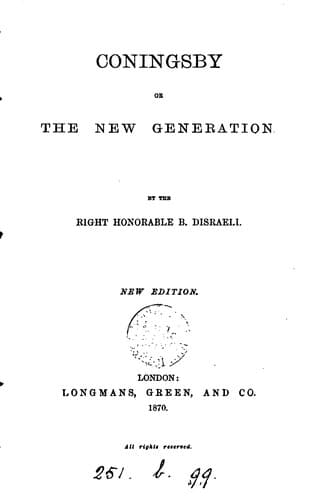
Coningsby; Or, The New GenerationDisraeli, Benjamin, Earl of Beaconsfield
General
Coningsby; Or, The New Generation
Disraeli, Benjamin, Earl of Beaconsfield
Great Britain -- Fiction; Political fiction; Politicians -- Fiction
little occurrence gave Rigby some few minutes to collect himself, at
the end of which he made the Princess several announcements of intended
arrangements, all of which pleased her mightily, though they were so
inconsistent with each other, that if she had not been a woman in a
passion, she must have detected that Rigby was lying. He assured her
almost in the same breath, that she was never to be separated from them,
and that she was to have any establishment in any country she liked. He
talked wildly of equipages, diamonds, shawls, opera-boxes; and while
her mind was bewildered with these dazzling objects, he, with intrepid
gravity, consulted her as to the exact amount she would like to have
apportioned, independent of her general revenue, for the purposes of
charity.
At the end of two hours, exhausted by her rage and soothed by these
visions, Madame Colonna having grown calm and reasonable, sighed and
murmured a complaint, that Lord Monmouth ought to have communicated this
important intelligence in person. Upon this Rigby instantly assured
her, that Lord Monmouth had been for some time waiting to do so, but
in consequence of her lengthened interview with Rigby, his Lordship had
departed for Richmond with Lucretia, where he hoped that Madame Colonna
and Mr. Rigby would join him. So it ended, with a morning drive and
suburban dinner; Rigby, after what he had gone through, finding no
difficulty in accounting for the other guests not being present, and
bringing home Madame Colonna in the evening, at times almost as gay and
good-tempered as usual, and almost oblivious of her disappointment.
When the Marquess met Madame Colonna he embraced her with great
courtliness, and from that time consulted her on every arrangement. He
took a very early occasion of presenting her with a diamond necklace of
great value. The Marquess was fond of making presents to persons to whom
he thought he had not behaved very well, and who yet spared him scenes.
The marriage speedily followed, by special license, at the villa of the
Right Hon. Nicholas Rigby, who gave away the bride. The wedding was very
select, but brilliant as the diamond necklace: a royal Duke and Duchess,
Lady St. Julians, and a few others. Mr. Ormsby presented the bride with
a bouquet of precious stones, and Lord Eskdale with a French fan in
a diamond frame. It was a fine day; Lord Monmouth, calm as if he were
winning the St. Leger; Lucretia, universally recognised as a beauty; all
the guests gay, the Princess Colonna especially.
The travelling carriage is at the door which is to bear away the happy
pair. Madame Colonna embraces Lucretia; the Marquess gives a grand bow:
they are gone. The guests remain awhile. A Prince of the blood will
propose a toast; there is another glass of champagne quaffed, another
ortolan devoured; and then they rise and disperse. Madame Colonna leaves
with Lady St. Julians, whose guest for a while she is to become. And in
a few minutes their host is alone.
Public-domain text, read in full here on John Shaqi.
Reviews
Reviews
No reviews yet
Be the first to share your thoughts on this work.
Elsewhere in the archive
Join the Discussion
Join the discussion
Sign in to leave a comment or review.
Sign InorCreate an account