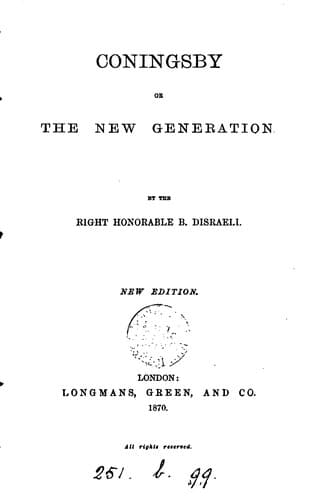
Coningsby; Or, The New GenerationDisraeli, Benjamin, Earl of Beaconsfield
General
Coningsby; Or, The New Generation
Disraeli, Benjamin, Earl of Beaconsfield
Great Britain -- Fiction; Political fiction; Politicians -- Fiction
Mr. Rigby retired into his library: the repose of the chamber must
have been grateful to his feelings after all this distraction. It was
spacious, well-stored, classically adorned, and opened on a beautiful
lawn. Rigby threw himself into an ample chair, crossed his legs, and
resting his head on his arm, apparently fell into deep contemplation.
He had some cause for reflection, and though we did once venture to
affirm that Rigby never either thought or felt, this perhaps may be the
exception that proves the rule.
He could scarcely refrain from pondering over the strange event which he
had witnessed, and at which he had assisted.
It was an incident that might exercise considerable influence over his
fortunes. His patron married, and married to one who certainly did
not offer to Mr. Rigby such a prospect of easy management as her
step-mother! Here were new influences arising; new characters, new
situations, new contingencies. Was he thinking of all this? He suddenly
jumps up, hurries to a shelf and takes down a volume. It is his
interleaved peerage, of which for twenty years he had been threatening
an edition. Turning to the Marquisate of Monmouth, he took up his pen
and thus made the necessary entry:
‘_Married, second time, August 3rd, 1837, The Princess Lucretia Colonna,
daughter of Prince Paul Colonna, born at Rome, February 16th, 1819._’
That was what Mr. Rigby called ‘a great fact.’ There was not a
peerage-compiler in England who had that date save himself.
Before we close this slight narrative of the domestic incidents that
occurred in the family of his grandfather since Coningsby quitted the
Castle, we must not forget to mention what happened to Villebecque and
Flora. Lord Monmouth took a great liking to the manager. He found him
very clever in many things independently of his profession; he was
useful to Lord Monmouth, and did his work in an agreeable manner. And
the future Lady Monmouth was accustomed to Flora, and found her useful
too, and did not like to lose her. And so the Marquess, turning all the
circumstances in his mind, and being convinced that Villebecque could
never succeed to any extent in England in his profession, and probably
nowhere else, appointed him, to Villebecque’s infinite satisfaction,
intendant of his household, with a considerable salary, while Flora
still lived with her kind step-father.
CHAPTER VII.
Public-domain text, read in full here on John Shaqi.
Reviews
Reviews
No reviews yet
Be the first to share your thoughts on this work.
Elsewhere in the archive
Join the Discussion
Join the discussion
Sign in to leave a comment or review.
Sign InorCreate an account