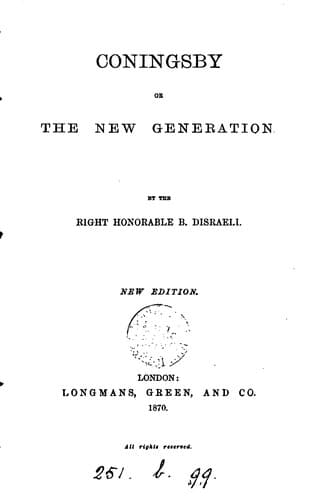
Coningsby; Or, The New GenerationDisraeli, Benjamin, Earl of Beaconsfield
General
Coningsby; Or, The New Generation
Disraeli, Benjamin, Earl of Beaconsfield
Great Britain -- Fiction; Political fiction; Politicians -- Fiction
Enveloped in a rich Indian shawl, and leaning back on a sofa, Lady
Monmouth was engaged in conversation with the courtly and classic Count
M----é, when, on casually turning her head, she observed entering the
saloon, Sidonia. She just caught his form bowing to the Duchess, and
instantly turned her head and replunged into her conversation with
increased interest. Lady Monmouth was a person who had the power of
seeing all about her, everything and everybody, without appearing to
look. She was conscious that Sidonia was approaching her neighbourhood.
Her heart beat in tumult; she dreaded to catch the eye of that very
individual whom she was so anxious to meet. He was advancing towards
the sofa. Instinctively, Lady Monmouth turned from the Count, and began
speaking earnestly to her other neighbour, a young daughter of the
house, innocent and beautiful, not yet quite fledged, trying her wings
in society under the maternal eye. She was surprised by the extreme
interest which her grand neighbour suddenly took in all her pursuits,
her studies, her daily walks in the Bois de Boulogne. Sidonia, as the
Marchioness had anticipated, had now reached the sofa. But no, it was to
the Count, and not to Lady Monmouth that he was advancing; and they were
immediately engaged in conversation. After some little time, when she
had become accustomed to his voice, and found her own heart throbbing
with less violence, Lucretia turned again, as if by accident, to the
Count, and met the glance of Sidonia. She meant to have received him
with haughtiness, but her self-command deserted her; and slightly rising
from the sofa, she welcomed him with a countenance of extreme pallor and
with some awkwardness.
His manner was such as might have assisted her, even had she been more
troubled. It was marked by a degree of respectful friendliness. He
expressed without reserve his pleasure at meeting her again; inquired
much how she had passed her time since they last parted; asked more than
once after the Marquess. The Count moved away; Sidonia took his seat.
His ease and homage combined greatly relieved her. She expressed to
him how kind her Lord would consider his society, for the Marquess had
suffered in health since Sidonia last saw him. His periodical gout had
left him, which made him ill and nervous. The Marquess received his
friends at dinner every day. Sidonia, particularly amiable, offered
himself as a guest for the following one.
‘And do you go to the great ball to-morrow?’ inquired Lucretia,
delighted with all that had occurred.
‘I always go to their balls,’ said Sidonia, ‘I have promised.’
Public-domain text, read in full here on John Shaqi.
Reviews
Reviews
No reviews yet
Be the first to share your thoughts on this work.
Elsewhere in the archive
Join the Discussion
Join the discussion
Sign in to leave a comment or review.
Sign InorCreate an account