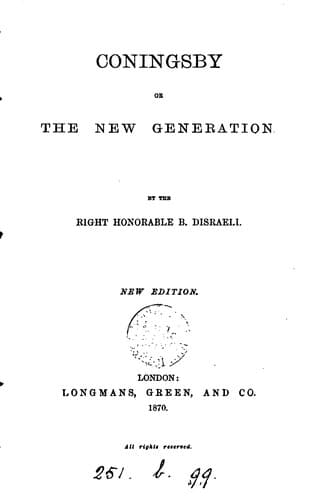
Coningsby; Or, The New GenerationDisraeli, Benjamin, Earl of Beaconsfield
General
Coningsby; Or, The New Generation
Disraeli, Benjamin, Earl of Beaconsfield
Great Britain -- Fiction; Political fiction; Politicians -- Fiction
There was a momentary pause; Lucretia happier than she had been for a
long time, her face a little flushed, and truly in a secret tumult of
sweet thoughts, remembered she had been long there, and offering her
hand to Sidonia, bade him adieu until to-morrow, while he, as was his
custom, soon repaired to the refined circle of the Countess de C-s-l-ne,
a lady whose manners he always mentioned as his fair ideal, and whose
house was his favourite haunt.
Before to-morrow comes, a word or two respecting two other characters
of this history connected with the family of Lord Monmouth. And first
of Flora. La Petite was neither very well nor very happy. Her hereditary
disease developed itself; gradually, but in a manner alarming to those
who loved her. She was very delicate, and suffered so much from the
weakness of her chest, that she was obliged to relinquish singing. This
was really the only tie between her and the Marchioness, who, without
being a petty tyrant, treated her often with unfeeling haughtiness. She
was, therefore, now rarely seen in the chambers of the great. In her own
apartments she found, indeed, some distraction in music, for which she
had a natural predisposition, but this was a pursuit that only fed
the morbid passion of her tender soul. Alone, listening only to sweet
sounds, or indulging in soft dreams that never could be realised, her
existence glided away like a vision, and she seemed to become every day
more fair and fragile. Alas! hers was the sad and mystic destiny to love
one whom she never met, and by whom, if she met him, she would scarcely,
perhaps, be recognised. Yet in that passion, fanciful, almost ideal,
her life was absorbed; nor for her did the world contain an existence,
a thought, a sensation, beyond those that sprang from the image of
the noble youth who had sympathised with her in her sorrows, and had
softened the hard fortunes of dependence by his generous sensibility.
Happy that, with many mortifications, it was still her lot to live under
the roof of one who bore his name, and in whose veins flowed the same
blood! She felt indeed for the Marquess, whom she so rarely saw, and
from whom she had never received much notice, prompted, it would seem,
by her fantastic passion, a degree of reverence, almost of affection,
which seemed occasionally, even to herself, as something inexplicable
and without reason.
Public-domain text, read in full here on John Shaqi.
Reviews
Reviews
No reviews yet
Be the first to share your thoughts on this work.
Elsewhere in the archive
Join the Discussion
Join the discussion
Sign in to leave a comment or review.
Sign InorCreate an account