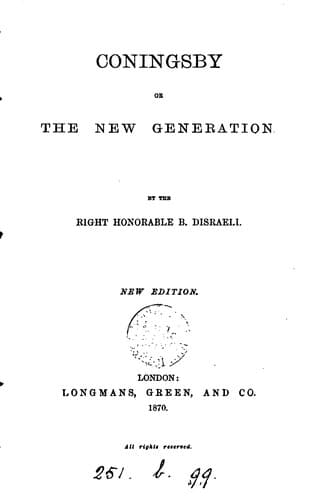
Coningsby; Or, The New GenerationDisraeli, Benjamin, Earl of Beaconsfield
General
Coningsby; Or, The New Generation
Disraeli, Benjamin, Earl of Beaconsfield
Great Britain -- Fiction; Political fiction; Politicians -- Fiction
‘Like all his ideas, sound, and high, and pure. I always duly
appreciated your brother’s great abilities, and, what is far more
important, his lofty mind. When I recollect our Eton days, I cannot
understand how more than two years have passed away without our being
together. I am sure the fault is mine. I might now have been at Oxford
instead of Paris. And yet,’ added Coningsby, ‘that would have been a sad
mistake, since I should not have had the happiness of being here.
‘Oh, yes, that would have been a sad mistake,’ said Miss Millbank.
‘Edith,’ said Sir Joseph, rejoining his niece, from whom he had been
momentarily separated, ‘Edith, that is Monsieur Thiers.’
In the meantime Sidonia reached the ball-room, and sitting near the
entrance was Lady Monmouth, who immediately addressed him. He was, as
usual, intelligent and unimpassioned, and yet not without a delicate
deference which is flattering to women, especially if not altogether
unworthy of it. Sidonia always admired Lucretia, and preferred her
society to that of most persons. But the Lady was in error in supposing
that she had conquered or could vanquish his heart. Sidonia was one of
those men, not so rare as may be supposed, who shrink, above all things,
from an adventure of gallantry with a woman in a position. He had
neither time nor temper for sentimental circumvolutions. He detested the
diplomacy of passion: protocols, protracted negotiations, conferences,
correspondence, treaties projected, ratified, violated. He had no genius
for the tactics of intrigue; your reconnoiterings, and marchings, and
countermarchings, sappings, and minings, assaults, sometimes surrenders,
and sometimes repulses. All the solemn and studied hypocrisies were to
him infinitely wearisome; and if the movements were not merely formal,
they irritated him, distracted his feelings, disturbed the tenor of his
mind, deranged his nervous system. Something of the old Oriental vein
influenced him in his carriage towards women. He was oftener behind the
scenes of the Opera-house than in his box; he delighted, too, in the
society of _etairai_; Aspasia was his heroine. Obliged to appear much in
what is esteemed pure society, he cultivated the acquaintance of clever
women, because they interested him; but in such saloons his feminine
acquaintances were merely psychological. No lady could accuse him of
trifling with her feelings, however decided might be his predilection
for her conversation. He yielded at once to an admirer; never trespassed
by any chance into the domain of sentiment; never broke, by any accident
or blunder, into the irregular paces of flirtation; was a man who
notoriously would never diminish by marriage the purity of his race;
and one who always maintained that passion and polished life were quite
incompatible. He liked the drawing-room, and he liked the Desert, but he
would not consent that either should trench on their mutual privileges.
Public-domain text, read in full here on John Shaqi.
Reviews
Reviews
No reviews yet
Be the first to share your thoughts on this work.
Elsewhere in the archive
Join the Discussion
Join the discussion
Sign in to leave a comment or review.
Sign InorCreate an account