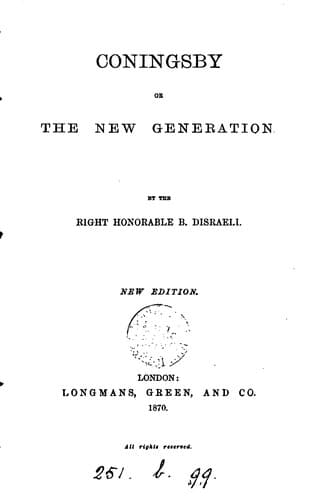
Coningsby; Or, The New GenerationDisraeli, Benjamin, Earl of Beaconsfield
General
Coningsby; Or, The New Generation
Disraeli, Benjamin, Earl of Beaconsfield
Great Britain -- Fiction; Political fiction; Politicians -- Fiction
The Princess Lucretia had yielded herself to the spell of Sidonia’s
society at Coningsby Castle, when she knew that marriage was impossible.
But she loved him; and with an Italian spirit. Now they met again,
and she was the Marchioness of Monmouth, a very great lady, very much
admired, and followed, and courted, and very powerful. It is our great
moralist who tells us, in the immortal page, that an affair of gallantry
with a great lady is more delightful than with ladies of a lower degree.
In this he contradicts the good old ballad; but certain it is that
Dr. Johnson announced to Boswell, ‘Sir, in the case of a Countess the
imagination is more excited.’
But Sidonia was a man on whom the conventional superiorities of life
produced as little effect as a flake falling on the glaciers of the high
Alps. His comprehension of the world and human nature was too vast
and complete; he understood too well the relative value of things to
appreciate anything but essential excellence; and that not too much. A
charming woman was not more charming to him because she chanced to be
an empress in a particular district of one of the smallest planets; a
charming woman under any circumstances was not an unique animal. When
Sidonia felt a disposition to be spellbound, he used to review in his
memory all the charming women of whom he had read in the books of all
literatures, and whom he had known himself in every court and clime,
and the result of his reflections ever was, that the charming woman in
question was by no means the paragon, which some who had read, seen,
and thought less, might be inclined to esteem her. There was, indeed,
no subject on which Sidonia discoursed so felicitously as on woman, and
none on which Lord Eskdale more frequently endeavoured to attract him.
He would tell you Talmudical stories about our mother Eve and the Queen
of Sheba, which would have astonished you. There was not a free lady of
Greece, Leontium and Phryne, Lais, Danae, and Lamia, the Egyptian girl
Thonis, respecting whom he could not tell you as many diverting tales as
if they were ladies of Loretto; not a nook of Athenseus, not an obscure
scholiast, not a passage in a Greek orator, that could throw light on
these personages, which was not at his command. What stories he would
tell you about Marc Antony and the actress Cytheris in their chariot
drawn by tigers! What a character would he paint of that Flora who gave
her gardens to the Roman people! It would draw tears to your eyes. No
man was ever so learned in the female manners of the last centuries of
polytheism as Sidonia. You would have supposed that he had devoted his
studies peculiarly to that period if you had not chanced to draw him
to the Italian middle ages. And even these startling revelations were
almost eclipsed by his anecdotes of the Court of Henry III. of France,
with every character of which he was as familiar as with the brilliant
groups that at this moment filled the saloons of Madame de R----d.
Public-domain text, read in full here on John Shaqi.
Reviews
Reviews
No reviews yet
Be the first to share your thoughts on this work.
Elsewhere in the archive
Join the Discussion
Join the discussion
Sign in to leave a comment or review.
Sign InorCreate an account