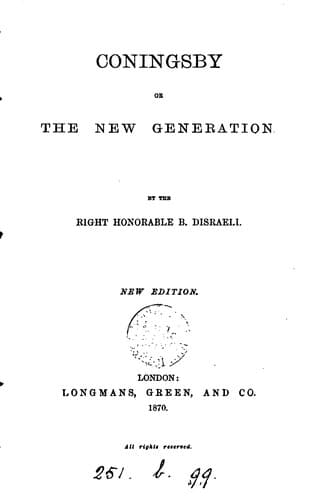
Coningsby; Or, The New GenerationDisraeli, Benjamin, Earl of Beaconsfield
General
Coningsby; Or, The New Generation
Disraeli, Benjamin, Earl of Beaconsfield
Great Britain -- Fiction; Political fiction; Politicians -- Fiction
CHAPTER III.
The image of Edith Millbank was the last thought of Coningsby, as he
sank into an agitated slumber. To him had hitherto in general been
accorded the precious boon of dreamless sleep. Homer tells us these
phantasms come from Jove; they are rather the children of a distracted
soul. Coningsby this night lived much in past years, varied by
painful perplexities of the present, which he could neither subdue
nor comprehend. The scene flitted from Eton to the castle of his
grandfather; and then he found himself among the pictures of the Rue de
Tronchet, but their owner bore the features of the senior Millbank. A
beautiful countenance that was alternately the face in the mysterious
picture, and then that of Edith, haunted him under all circumstances. He
woke little refreshed; restless, and yet sensible of some secret joy.
He woke to think of her of whom he had dreamed. The light had dawned on
his soul. Coningsby loved.
Ah! what is that ambition that haunts our youth, that thirst for power
or that lust of fame that forces us from obscurity into the sunblaze of
the world, what are these sentiments so high, so vehement, so ennobling?
They vanish, and in an instant, before the glance of a woman!
Coningsby had scarcely quitted her side the preceding eve. He hung
upon the accents of that clear sweet voice, and sought, with tremulous
fascination, the gleaming splendour of those soft dark eyes. And now
he sat in his chamber, with his eyes fixed on vacancy. All thoughts and
feelings, pursuits, desires, life, merge in one absorbing sentiment.
It is impossible to exist without seeing her again, and instantly. He
had requested and gained permission to call on Lady Wallinger; he would
not lose a moment in availing himself of it. As early as was tolerably
decorous, and before, in all probability, they could quit their hotel,
Coningsby repaired to the Rue de Rivoli to pay his respects to his new
friends.
As he walked along, he indulged in fanciful speculations which connected
Edith and the mysterious portrait of his mother. He felt himself, as
it were, near the fulfilment of some fate, and on the threshold of some
critical discovery. He recalled the impatient, even alarmed, expressions
of Rigby at Montem six years ago, when he proposed to invite young
Millbank to his grandfather’s dinner; the vindictive feud that existed
between the two families, and for which political opinion, or even party
passion, could not satisfactorily account; and he reasoned himself into
a conviction, that the solution of many perplexities was at hand, and
that all would be consummated to the satisfaction of every one, by his
unexpected but inevitable agency.
Coningsby found Sir Joseph alone. The worthy Baronet was at any rate
no participator in Mr. Millbank’s vindictive feelings against Lord
Monmouth. On the contrary, he had a very high respect for a Marquess,
whatever might be his opinions, and no mean consideration for a
Marquess’ grandson.
Public-domain text, read in full here on John Shaqi.
Reviews
Reviews
No reviews yet
Be the first to share your thoughts on this work.
Elsewhere in the archive
Join the Discussion
Join the discussion
Sign in to leave a comment or review.
Sign InorCreate an account