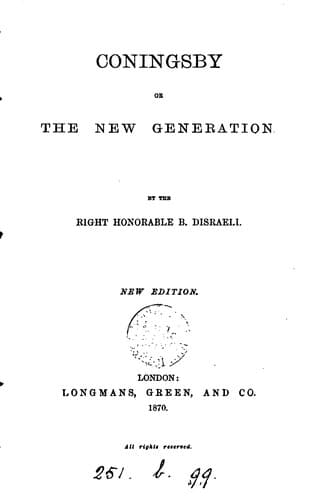
Coningsby; Or, The New GenerationDisraeli, Benjamin, Earl of Beaconsfield
General
Coningsby; Or, The New Generation
Disraeli, Benjamin, Earl of Beaconsfield
Great Britain -- Fiction; Political fiction; Politicians -- Fiction
When Coningsby returned to his rooms, those rooms which he was soon
about to quit for ever, in arranging some papers preparatory to his
removal, his eye lighted on a too-long unanswered letter of Oswald
Millbank. Coningsby had often projected a visit to Oxford, which he much
desired to make, but hitherto it had been impossible for him to effect
it, except in the absence of Millbank; and he had frequently postponed
it that he might combine his first visit to that famous seat of learning
with one to his old schoolfellow and friend. Now that was practicable.
And immediately Coningsby wrote to apprise Millbank that he had
taken his degree, was free, and prepared to pay him immediately the
long-projected visit. Three years and more had elapsed since they had
quitted Eton. How much had happened in the interval! What new ideas, new
feelings, vast and novel knowledge! Though they had not met, they were
nevertheless familiar with the progress and improvement of each other’s
minds. Their suggestive correspondence was too valuable to both of them
to have been otherwise than cherished. And now they were to meet on
the eve of entering that world for which they had made so sedulous a
preparation.
CHAPTER II.
There are few things in life more interesting than an unrestrained
interchange of ideas with a congenial spirit, and there are few things
more rare. How very seldom do you encounter in the world a man of great
abilities, acquirements, experience, who will unmask his mind, unbutton
his brains, and pour forth in careless and picturesque phrase all the
results of his studies and observation; his knowledge of men, books, and
nature. On the contrary, if a man has by any chance what he conceives
an original idea, he hoards it as if it were old gold; and rather avoids
the subject with which he is most conversant, from fear that you may
appropriate his best thoughts. One of the principal causes of our
renowned dulness in conversation is our extreme intellectual jealousy.
It must be admitted that in this respect authors, but especially poets,
bear the palm. They never think they are sufficiently appreciated, and
live in tremor lest a brother should distinguish himself. Artists have
the repute of being nearly as bad. And as for a small rising politician,
a clever speech by a supposed rival or suspected candidate for office
destroys his appetite and disturbs his slumbers.
One of the chief delights and benefits of travel is, that one is
perpetually meeting men of great abilities, of original mind, and rare
acquirements, who will converse without reserve. In these discourses
the intellect makes daring leaps and marvellous advances. The tone that
colours our afterlife is often caught in these chance colloquies, and
the bent given that shapes a career.
Public-domain text, read in full here on John Shaqi.
Reviews
Reviews
No reviews yet
Be the first to share your thoughts on this work.
Elsewhere in the archive
Join the Discussion
Join the discussion
Sign in to leave a comment or review.
Sign InorCreate an account