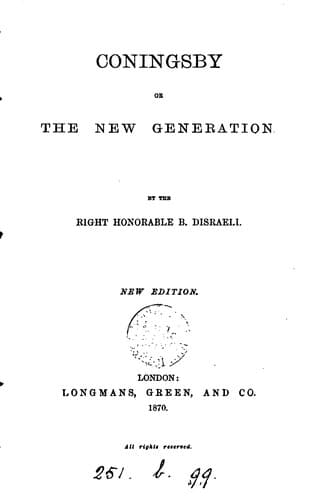
Coningsby; Or, The New GenerationDisraeli, Benjamin, Earl of Beaconsfield
General
Coningsby; Or, The New Generation
Disraeli, Benjamin, Earl of Beaconsfield
Great Britain -- Fiction; Political fiction; Politicians -- Fiction
And yet perhaps there is no occasion when the heart is more open, the
brain more quick, the memory more rich and happy, or the tongue more
prompt and eloquent, than when two school-day friends, knit by every
sympathy of intelligence and affection, meet at the close of their
college careers, after a long separation, hesitating, as it were, on
the verge of active life, and compare together their conclusions of the
interval; impart to each other all their thoughts and secret plans
and projects; high fancies and noble aspirations; glorious visions of
personal fame and national regeneration.
Ah! why should such enthusiasm ever die! Life is too short to be
little. Man is never so manly as when he feels deeply, acts boldly, and
expresses himself with frankness and with fervour.
Most assuredly there never was a congress of friendship wherein more was
said and felt than in this meeting, so long projected, and yet perhaps
on the whole so happily procrastinated, between Coningsby and Millbank.
In a moment they seemed as if they had never parted. Their faithful
correspondence indeed had maintained the chain of sentiment unbroken.
But details are only for conversation. Each poured forth his mind
without stint. Not an author that had influenced their taste or judgment
but was canvassed and criticised; not a theory they had framed or a
principle they had adopted that was not confessed. Often, with boyish
glee still lingering with their earnest purpose, they shouted as they
discovered that they had formed the same opinion or adopted the same
conclusion. They talked all day and late into the night. They condensed
into a week the poignant conclusions of three years of almost unbroken
study. And one night, as they sat together in Millbank’s rooms at
Oriel, their conversation having for some time taken a political colour,
Millbank said,
‘Now tell me, Coningsby, exactly what you conceive to be the state of
parties in this country; for it seems to me that if we penetrate the
surface, the classification must be more simple than their many names
would intimate.’
‘The principle of the exclusive constitution of England having been
conceded by the Acts of 1827-8-32,’ said Coningsby, ‘a party has arisen
in the State who demand that the principle of political liberalism
shall consequently be carried to its extent; which it appears to them is
impossible without getting rid of the fragments of the old constitution
that remain. This is the destructive party; a party with distinct and
intelligible principles. They seek a specific for the evils of our
social system in the general suffrage of the population.
Public-domain text, read in full here on John Shaqi.
Reviews
Reviews
No reviews yet
Be the first to share your thoughts on this work.
Elsewhere in the archive
Join the Discussion
Join the discussion
Sign in to leave a comment or review.
Sign InorCreate an account