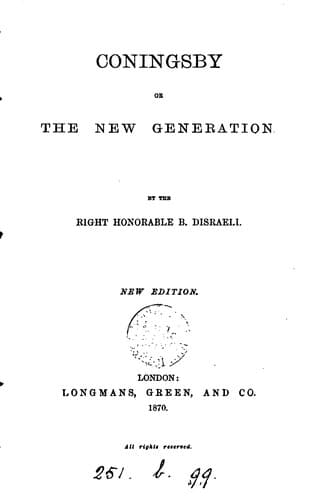
Coningsby; Or, The New GenerationDisraeli, Benjamin, Earl of Beaconsfield
General
Coningsby; Or, The New Generation
Disraeli, Benjamin, Earl of Beaconsfield
Great Britain -- Fiction; Political fiction; Politicians -- Fiction
‘Many men in this country,’ said Millbank, ‘and especially in the class
to which I belong, are reconciled to the contemplation of democracy;
because they have accustomed themselves to believe, that it is the
only power by which we can sweep away those sectional privileges and
interests that impede the intelligence and industry of the community.’
‘And yet,’ said Coningsby, ‘the only way to terminate what, in the
language of the present day, is called Class Legislation, is not to
entrust power to classes. You would find a Locofoco majority as much
addicted to Class Legislation as a factitious aristocracy. The only
power that has no class sympathy is the Sovereign.’
‘But suppose the case of an arbitrary Sovereign, what would be your
check against him?’
‘The same as against an arbitrary Parliament.’
‘But a Parliament is responsible.’
‘To whom?’
‘To their constituent body.’
‘Suppose it was to vote itself perpetual?’
‘But public opinion would prevent that.’
‘And is public opinion of less influence on an individual than on a
body?’
‘But public opinion may be indifferent. A nation may be misled, may be
corrupt.’
‘If the nation that elects the Parliament be corrupt, the elected body
will resemble it. The nation that is corrupt deserves to fall. But this
only shows that there is something to be considered beyond forms of
government, national character. And herein mainly should we repose our
hopes. If a nation be led to aim at the good and the great, depend upon
it, whatever be its form, the government will respond to its convictions
and its sentiments.’
‘Do you then declare against Parliamentary government.’
‘Far from it: I look upon political change as the greatest of evils,
for it comprehends all. But if we have no faith in the permanence of
the existing settlement, if the very individuals who established it are,
year after year, proposing their modifications or their reconstructions;
so also, while we uphold what exists, ought we to prepare ourselves for
the change we deem impending?
‘Now I would not that either ourselves, or our fellow-citizens, should
be taken unawares as in 1832, when the very men who opposed the Reform
Bill offered contrary objections to it which destroyed each other, so
ignorant were they of its real character, its historical causes, its
political consequences. We should now so act that, when the occasions
arrives, we should clearly comprehend what we want, and have formed an
opinion as to the best means by which that want can be supplied.
Public-domain text, read in full here on John Shaqi.
Reviews
Reviews
No reviews yet
Be the first to share your thoughts on this work.
Elsewhere in the archive
Join the Discussion
Join the discussion
Sign in to leave a comment or review.
Sign InorCreate an account