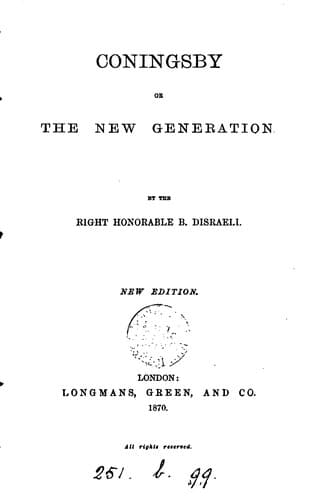
Coningsby; Or, The New GenerationDisraeli, Benjamin, Earl of Beaconsfield
General
Coningsby; Or, The New Generation
Disraeli, Benjamin, Earl of Beaconsfield
Great Britain -- Fiction; Political fiction; Politicians -- Fiction
‘For this purpose I would accustom the public mind to the contemplation
of an existing though torpid power in the constitution, capable
of removing our social grievances, were we to transfer to it those
prerogatives which the Parliament has gradually usurped, and used in
a manner which has produced the present material and moral
disorganisation. The House of Commons is the house of a few; the
Sovereign is the sovereign of all. The proper leader of the people is
the individual who sits upon the throne.’
‘Then you abjure the Representative principle?’
‘Why so? Representation is not necessarily, or even in a principal
sense, Parliamentary. Parliament is not sitting at this moment, and yet
the nation is represented in its highest as well as in its most minute
interests. Not a grievance escapes notice and redress. I see in the
newspaper this morning that a pedagogue has brutally chastised his
pupil. It is a fact known over all England. We must not forget that a
principle of government is reserved for our days that we shall not find
in our Aristotles, or even in the forests of Tacitus, nor in our Saxon
Wittenagemotes, nor in our Plantagenet parliaments. Opinion is now
supreme, and Opinion speaks in print. The representation of the Press is
far more complete than the representation of Parliament. Parliamentary
representation was the happy device of a ruder age, to which it was
admirably adapted: an age of semi-civilisation, when there was a leading
class in the community; but it exhibits many symptoms of desuetude.
It is controlled by a system of representation more vigorous and
comprehensive; which absorbs its duties and fulfils them more
efficiently, and in which discussion is pursued on fairer terms, and
often with more depth and information.’
‘And to what power would you entrust the function of Taxation?’
‘To some power that would employ it more discreetly than in creating
our present amount of debt, and in establishing our present system of
imposts.
‘In a word, true wisdom lies in the policy that would effect its ends
by the influence of opinion, and yet by the means of existing forms.
Nevertheless, if we are forced to revolutions, let us propose to our
consideration the idea of a free monarchy, established on fundamental
laws, itself the apex of a vast pile of municipal and local government,
ruling an educated people, represented by a free and intellectual press.
Before such a royal authority, supported by such a national opinion, the
sectional anomalies of our country would disappear. Under such a system,
where qualification would not be parliamentary, but personal, even
statesmen would be educated; we should have no more diplomatists who
could not speak French, no more bishops ignorant of theology, no more
generals-in-chief who never saw a field.
Public-domain text, read in full here on John Shaqi.
Reviews
Reviews
No reviews yet
Be the first to share your thoughts on this work.
Elsewhere in the archive
Join the Discussion
Join the discussion
Sign in to leave a comment or review.
Sign InorCreate an account