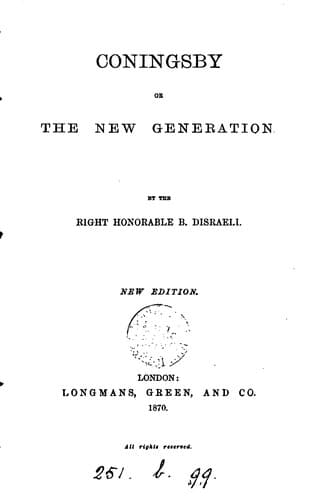
Coningsby; Or, The New GenerationDisraeli, Benjamin, Earl of Beaconsfield
General
Coningsby; Or, The New Generation
Disraeli, Benjamin, Earl of Beaconsfield
Great Britain -- Fiction; Political fiction; Politicians -- Fiction
Coningsby was springing up the staircase, now not so crowded as it had
been, and met a retiring party; he was about to say a passing word to a
gentleman as he went by, when, suddenly, Coningsby turned deadly pale.
The gentleman could hardly be the cause, for it was the gracious and
handsome presence of Lord Beaumanoir: the lady resting on his arm was
Edith. They moved on while he was motionless; yet Edith and himself
had exchanged glances. His was one of astonishment; but what was the
expression of hers? She must have recognised him before he had observed
her. She was collected, and she expressed the purpose of her mind in
a distant and haughty recognition. Coningsby remained for a moment
stupefied; then suddenly turning back, he bounded downstairs and hurried
into the cloak-room. He met Lady Wallinger; he spoke rapidly, he held
her hand, did not listen to her answers, his eyes wandered about. There
were many persons present, at length he recognised Edith enveloped in
her mantle. He went forward, he looked at her, as if he would have read
her soul; he said something. She changed colour as he addressed her,
but seemed instantly by an effort to rally and regain her equanimity;
replied to his inquiries with extreme brevity, and Lady Wallinger’s
carriage being announced, moved away with the same slight haughty salute
as before, on the arm of Lord Beaumanoir.
CHAPTER II.
Sadness fell over the once happy family of Millbank after the departure
of Coningsby from Hellingsley. When the first pang was over, Edith
had found some solace in the sympathy of her aunt, who had always
appreciated and admired Coningsby; but it was a sympathy which aspired
only to soften sorrow, and not to create hope. But Lady Wallinger,
though she lengthened her visit for the sake of her niece, in time
quitted them; and then the name of Coningsby was never heard by Edith.
Her brother, shortly after the sorrowful and abrupt departure of his
friend, had gone to the factories, where he remained, and of which, in
future, it was intended that he should assume the principal direction.
Mr. Millbank himself, sustained at first by the society of his friend
Sir Joseph, to whom he was attached, and occupied with daily reports
from his establishment and the transaction of the affairs with his
numerous and busy constituents, was for a while scarcely conscious of
the alteration which had taken place in the demeanour of his daughter.
But when they were once more alone together, it was impossible any
longer to be blind to the great change. That happy and equable gaiety of
spirit, which seemed to spring from an innocent enjoyment of existence,
and which had ever distinguished Edith, was wanting. Her sunny glance
was gone. She was not indeed always moody and dispirited, but she was
fitful, unequal in her tone. That temper whose sweetness had been a
domestic proverb had become a little uncertain. Not that her affection
for her father was diminished, but there were snatches of unusual
Public-domain text, read in full here on John Shaqi.
Reviews
Reviews
No reviews yet
Be the first to share your thoughts on this work.
Elsewhere in the archive
Join the Discussion
Join the discussion
Sign in to leave a comment or review.
Sign InorCreate an account