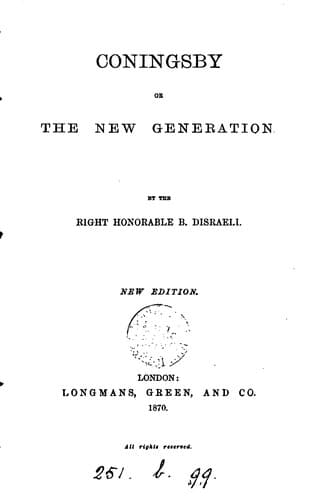
Coningsby; Or, The New GenerationDisraeli, Benjamin, Earl of Beaconsfield
General
Coningsby; Or, The New Generation
Disraeli, Benjamin, Earl of Beaconsfield
Great Britain -- Fiction; Political fiction; Politicians -- Fiction
irritability which momentarily escaped her, followed by bursts of
tenderness that were the creatures of compunction. And often, after some
hasty word, she would throw her arms round her father’s neck with the
fondness of remorse. She pursued her usual avocations, for she had
really too well-regulated a mind, she was in truth a person of
too strong an intellect, to neglect any source of occupation and
distraction. Her flowers, her pencil, and her books supplied her with
these; and music soothed, and at times beguiled, her agitated thoughts.
But there was no joy in the house, and in time Mr. Millbank felt it.
Mr. Millbank was vexed, irritated, grieved. Edith, his Edith, the pride
and delight of his existence, who had been to him only a source of
exultation and felicity, was no longer happy, was perhaps pining away;
and there was the appearance, the unjust appearance that he, her fond
father, was the cause and occasion of all this wretchedness. It would
appear that the name of Coningsby, to which he now owed a great debt of
gratitude, was still doomed to bear him mortification and misery. Truly
had the young man said that there was a curse upon their two families.
And yet, on reflection, it still seemed to Mr. Millbank that he had
acted with as much wisdom and real kindness as decision. How otherwise
was he to have acted? The union was impossible; the speedier their
separation, therefore, clearly the better. Unfortunate, indeed, had been
his absence from Hellingsley; unquestionably his presence might have
prevented the catastrophe. Oswald should have hindered all this. And
yet Mr. Millbank could not shut his eyes to the devotion of his son to
Coningsby. He felt he could count on no assistance in this respect from
that quarter. Yet how hard upon him that he should seem to figure as
a despot or a tyrant to his own children, whom he loved, when he had
absolutely acted in an inevitable manner! Edith seemed sad, Oswald
sullen; all was changed. All the objects for which this clear-headed,
strong-minded, kind-hearted man had been working all his life, seemed
to be frustrated. And why? Because a young man had made love to his
daughter, who was really in no manner entitled to do so.
As the autumn drew on, Mr. Millbank found Hellingsley, under existing
circumstances, extremely wearisome; and he proposed to his daughter that
they should pay a visit to their earlier home. Edith assented without
difficulty, but without interest. And yet, as Mr. Millbank immediately
perceived, the change was a judicious one; for certainly the spirits
of Edith seemed to improve after her return to their valley. There were
more objects of interest: change, too, is always beneficial. If
Mr. Millbank had been aware that Oswald had received a letter from
Coningsby, written before he quitted Spain, perhaps he might have
recognised a more satisfactory reason for the transient liveliness of
his daughter which had so greatly gratified him.
Public-domain text, read in full here on John Shaqi.
Reviews
Reviews
No reviews yet
Be the first to share your thoughts on this work.
Elsewhere in the archive
Join the Discussion
Join the discussion
Sign in to leave a comment or review.
Sign InorCreate an account