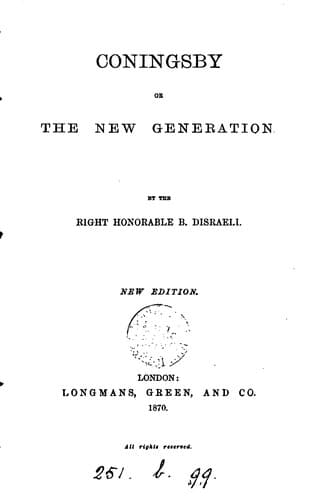
Coningsby; Or, The New GenerationDisraeli, Benjamin, Earl of Beaconsfield
General
Coningsby; Or, The New Generation
Disraeli, Benjamin, Earl of Beaconsfield
Great Britain -- Fiction; Political fiction; Politicians -- Fiction
About a month after Christmas, the meeting of Parliament summoned Mr.
Millbank up to London; and he had wished Edith to accompany him. But
London in February to Edith, without friends or connections, her father
always occupied and absent from her day and night, seemed to them
all, on reflection, to be a life not very conducive to health or
cheerfulness, and therefore she remained with her brother. Oswald had
heard from Coningsby again from Rome; but at the period he wrote he did
not anticipate his return to England. His tone was affectionate, but
dispirited.
Lady Wallinger went up to London after Easter for the season, and Mr.
Millbank, now that there was a constant companion for his daughter, took
a house and carried Edith back with him to London. Lady Wallinger,
who had great wealth and great tact, had obtained by degrees a
not inconsiderable position in society. She had a fine house in a
fashionable situation, and gave profuse entertainments. The Whigs
were under obligations to her husband, and the great Whig ladies were
gratified to find in his wife a polished and pleasing person, to whom
they could be courteous without any annoyance. So that Edith, under the
auspices of her aunt, found herself at once in circles which otherwise
she might not easily have entered, but which her beauty, grace, and
experience of the most refined society of the Continent, qualified
her to shine in. One evening they met the Marquis of Beaumanoir, their
friend of Rome and Paris, and admirer of Edith, who from that time was
seldom from their side. His mother, the Duchess, immediately called both
on the Millbanks and the Wallingers; glad, not only to please her son,
but to express that consideration for Mr. Millbank which the Duke always
wished to show. It was, however, of no use; nothing would induce Mr.
Millbank ever to enter what he called aristocratic society. He liked the
House of Commons; never paired off; never missed a moment of it; worked
at committees all the morning, listened attentively to debates all the
night; always dined at Bellamy’s when there was a house; and when there
was not, liked dining at the Fishmongers’ Company, the Russia Company,
great Emigration banquets, and other joint-stock festivities. That was
his idea of rational society; business and pleasure combined; a good
dinner, and good speeches afterwards.
Public-domain text, read in full here on John Shaqi.
Reviews
Reviews
No reviews yet
Be the first to share your thoughts on this work.
Elsewhere in the archive
Join the Discussion
Join the discussion
Sign in to leave a comment or review.
Sign InorCreate an account