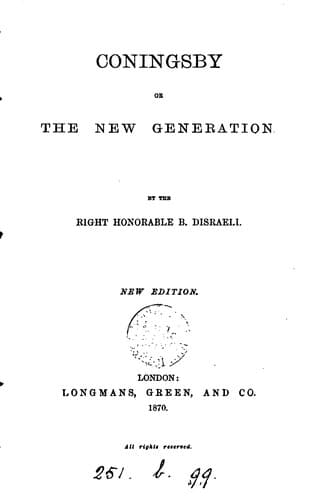
Coningsby; Or, The New GenerationDisraeli, Benjamin, Earl of Beaconsfield
General
Coningsby; Or, The New Generation
Disraeli, Benjamin, Earl of Beaconsfield
Great Britain -- Fiction; Political fiction; Politicians -- Fiction
Lady Monmouth was reclining on a sofa in that beautiful boudoir which
had been fitted up under the superintendence of Mr. Rigby, but as he
then believed for the Princess Colonna. The walls were hung with amber
satin, painted by Delaroche with such subjects as might be expected from
his brilliant and picturesque pencil. Fair forms, heroes and heroines
in dazzling costume, the offspring of chivalry merging into what is
commonly styled civilisation, moved in graceful or fantastic groups amid
palaces and gardens. The ceiling, carved in the deep honeycomb fashion
of the Saracens, was richly gilt and picked out in violet. Upon a violet
carpet of velvet was represented the marriage of Cupid and Psyche.
It was about two hours after Coningsby had quitted Monmouth House, and
Flora came in, sent for by Lady Monmouth as was her custom, to read to
her as she was employed with some light work.
‘’Tis a new book of Sue,’ said Lucretia. ‘They say it is good.’
Flora, seated by her side, began to read. Reading was an accomplishment
which distinguished Flora; but to-day her voice faltered, her expression
was uncertain; she seemed but imperfectly to comprehend her page. More
than once Lady Monmouth looked round at her with an inquisitive glance.
Suddenly Flora stopped and burst into tears.
‘O! madam,’ she at last exclaimed, ‘if you would but speak to Mr.
Coningsby, all might be right!’
‘What is this?’ said Lady Monmouth, turning quickly on the sofa; then,
collecting herself in an instant, she continued with less abruptness,
and more suavity than usual, ‘Tell me, Flora, what is it; what is the
matter?’
‘My Lord,’ sobbed Flora, ‘has quarrelled with Mr. Coningsby.’
An expression of eager interest came over the countenance of Lucretia.
‘Why have they quarrelled?’
‘I do not know they have quarrelled; it is not, perhaps, a right term;
but my Lord is very angry with Mr. Coningsby.’
‘Not very angry, I should think, Flora; and about what?’
‘Oh! very angry, madam,’ said Flora, shaking her head mournfully. ‘My
Lord told M. Villebecque that perhaps Mr. Coningsby would never enter
the house again.’
‘Was it to-day?’ asked Lucretia.
‘This morning. Mr. Coningsby has only left this hour or two. He will not
do what my Lord wishes, about some seat in the Chamber. I do not know
exactly what it is; but my Lord is in one of his moods of terror: my
father is frightened even to go into his room when he is so.’
‘Has Mr. Rigby been here to-day?’ asked Lucretia.
‘Mr. Rigby is not in town. My father went for Mr. Rigby this morning
before Mr. Coningsby came, and he found that Mr. Rigby was not in town.
That is why I know it.’
Lady Monmouth rose from her sofa, and walked once or twice up and down
the room. Then turning to Flora, she said, ‘Go away now: the book is
stupid; it does not amuse me. Stop: find out all you can for me about
the quarrel before I speak to Mr. Coningsby.’
Public-domain text, read in full here on John Shaqi.
Reviews
Reviews
No reviews yet
Be the first to share your thoughts on this work.
Elsewhere in the archive
Join the Discussion
Join the discussion
Sign in to leave a comment or review.
Sign InorCreate an account