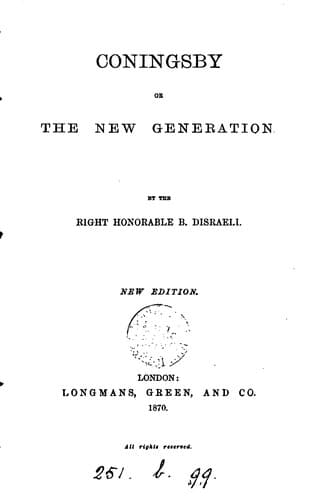
Coningsby; Or, The New GenerationDisraeli, Benjamin, Earl of Beaconsfield
General
Coningsby; Or, The New Generation
Disraeli, Benjamin, Earl of Beaconsfield
Great Britain -- Fiction; Political fiction; Politicians -- Fiction
Flora quitted the room. Lucretia remained for some time in meditation;
then she wrote a few lines, which she despatched at once to Mr. Rigby.
CHAPTER VI.
What a great man was the Right Honourable Nicholas Rigby! Here was one
of the first peers of England, and one of the finest ladies in London,
both waiting with equal anxiety his return to town; and unable to
transact two affairs of vast importance, yet wholly unconnected, without
his interposition! What was the secret of the influence of this man,
confided in by everybody, trusted by none? His counsels were not deep,
his expedients were not felicitous; he had no feeling, and he could
create no sympathy. It is that, in most of the transactions of life,
there is some portion which no one cares to accomplish, and which
everybody wishes to be achieved. This was always the portion of Mr.
Rigby. In the eye of the world he had constantly the appearance of being
mixed up with high dealings, and negotiations and arrangements of fine
management, whereas in truth, notwithstanding his splendid livery and
the airs he gave himself in the servants’ hall, his real business in
life had ever been, to do the dirty work.
Mr. Rigby had been shut up much at his villa of late. He was concocting,
you could not term it composing, an article, a ‘very slashing article,’
which was to prove that the penny postage must be the destruction of the
aristocracy. It was a grand subject, treated in his highest style. His
parallel portraits of Rowland Hill the conqueror of Almarez and Rowland
Hill the deviser of the cheap postage were enormously fine. It was full
of passages in italics, little words in great capitals, and almost drew
tears. The statistical details also were highly interesting and novel.
Several of the old postmen, both twopenny and general, who had been in
office with himself, and who were inspired with an equal zeal against
that spirit of reform of which they had alike been victims, supplied him
with information which nothing but a breach of ministerial duty could
have furnished. The prophetic peroration as to the irresistible progress
of democracy was almost as powerful as one of Rigby’s speeches on
Aldborough or Amersham. There never was a fellow for giving a good
hearty kick to the people like Rigby. Himself sprung from the dregs of
the populace, this was disinterested. What could be more patriotic and
magnanimous than his Jeremiads over the fall of the Montmorencis and the
Crillons, or the possible catastrophe of the Percys and the Manners! The
truth of all this hullabaloo was that Rigby had a sly pension which,
by an inevitable association of ideas, he always connected with the
maintenance of an aristocracy. All his rigmarole dissertations on the
French revolution were impelled by this secret influence; and when he
wailed over ‘la guerre aux châteaux,’ and moaned like a mandrake over
Nottingham Castle in flames, the rogue had an eye all the while to
quarter-day!
Public-domain text, read in full here on John Shaqi.
Reviews
Reviews
No reviews yet
Be the first to share your thoughts on this work.
Elsewhere in the archive
Join the Discussion
Join the discussion
Sign in to leave a comment or review.
Sign InorCreate an account