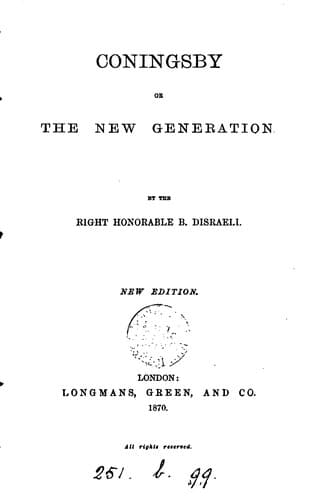
Coningsby; Or, The New GenerationDisraeli, Benjamin, Earl of Beaconsfield
General
Coningsby; Or, The New Generation
Disraeli, Benjamin, Earl of Beaconsfield
Great Britain -- Fiction; Political fiction; Politicians -- Fiction
‘It shall be done,’ said Rigby; ‘it must be done. If once the notion
gets wind that one of the Castle family may perchance stand for
Darlford, all the present combinations will be disorganised. It must be
done at once. I know that the Government will dissolve.’
‘So I hear for certain,’ said Lucretia. ‘Be sure there is no time to
lose. What does he want with you to-day?’
‘I know not: there are so many things.’
‘To be sure; and yet I cannot doubt he will speak of this quarrel.
Let not the occasion be lost. Whatever his mood, the subject may be
introduced. If good, you will guide him more easily; if dark, the love
for the Hellingsley girl, the fact of the brother being in his castle,
drinking his wine, riding his horses, ordering about his servants; you
will omit no details: a Millbank quite at home at Coningsby will lash
him to madness! ‘Tis quite ripe. Not a word that you have seen me. Go,
go, or he may hear that you have arrived. I shall be at home all the
morning. It will be but gallant that you should pay me a little visit
when you have transacted your business. You understand. _Au revoir!_’
Lady Monmouth took up again her French novel; but her eyes soon glanced
over the page, unattached by its contents. Her own existence was too
interesting to find any excitement in fiction. It was nearly three years
since her marriage; that great step which she ever had a conviction was
to lead to results still greater. Of late she had often been filled with
a presentiment that they were near at hand; never more so than on
this day. Irresistible was the current of associations that led her to
meditate on freedom, wealth, power; on a career which should at the same
time dazzle the imagination and gratify her heart. Notwithstanding the
gossip of Paris, founded on no authentic knowledge of her husband’s
character or information, based on the haphazard observations of the
floating multitude, Lucretia herself had no reason to fear that her
influence over Lord Monmouth, if exerted, was materially diminished. But
satisfied that he had formed no other tie, with her ever the test of
her position, she had not thought it expedient, and certainly would have
found it irksome, to maintain that influence by any ostentatious means.
She knew that Lord Monmouth was capricious, easily wearied, soon palled;
and that on men who have no affections, affection has no hold. Their
passions or their fancies, on the contrary, as it seemed to her, are
rather stimulated by neglect or indifference, provided that they are not
systematic; and the circumstance of a wife being admired by one who is
not her husband sometimes wonderfully revives the passion or renovates
the respect of him who should be devoted to her.
Public-domain text, read in full here on John Shaqi.
Reviews
Reviews
No reviews yet
Be the first to share your thoughts on this work.
Elsewhere in the archive
Join the Discussion
Join the discussion
Sign in to leave a comment or review.
Sign InorCreate an account