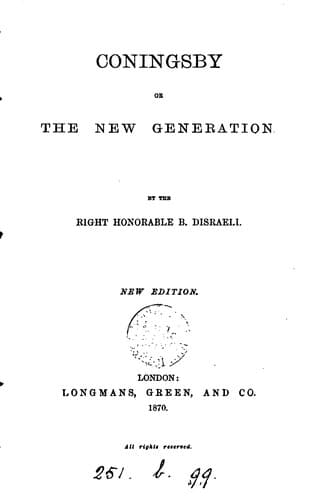
Coningsby; Or, The New GenerationDisraeli, Benjamin, Earl of Beaconsfield
General
Coningsby; Or, The New Generation
Disraeli, Benjamin, Earl of Beaconsfield
Great Britain -- Fiction; Political fiction; Politicians -- Fiction
The health of Lord Monmouth was the subject which never was long absent
from the vigilance or meditation of Lucretia. She was well assured that
his life was no longer secure. She knew that after their marriage he had
made a will, which secured to her a large portion of his great wealth in
case of their having no issue, and after the accident at Paris all
hope in that respect was over. Recently the extreme anxiety which Lord
Monmouth had evinced about terminating the abeyance of the barony to
which his first wife was a co-heiress in favour of his grandson, had
alarmed Lucretia. To establish in the land another branch of the house
of Coningsby was evidently the last excitement of Lord Monmouth, and
perhaps a permanent one. If the idea were once accepted, notwithstanding
the limit to its endowment which Lord Monmouth might at the first start
contemplate, Lucretia had sufficiently studied his temperament to be
convinced that all his energies and all his resources would ultimately
be devoted to its practical fulfilment. Her original prejudice against
Coningsby and jealousy of his influence had therefore of late been
considerably aggravated; and the intelligence that for the first time
there was a misunderstanding between Coningsby and her husband filled
her with excitement and hope. She knew her Lord well enough to feel
assured that the cause for displeasure in the present instance could not
be a light one; she resolved instantly to labour that it should not
be transient; and it so happened that she had applied for aid in this
endeavour to the very individual in whose power it rested to accomplish
all her desire, while in doing so he felt at the same time he was
defending his own position and advancing his own interests.
Lady Monmouth was now waiting with some excitement the return of Mr.
Rigby. His interview with his patron was of unusual length. An hour, and
more than an hour, had elapsed. Lady Monmouth again threw aside the book
which more than once she had discarded. She paced the room, restless
rather than disquieted. She had complete confidence in Rigby’s ability
for the occasion; and with her knowledge of Lord Monmouth’s character,
she could not contemplate the possibility of failure, if the
circumstances were adroitly introduced to his consideration. Still time
stole on: the harassing and exhausting process of suspense was acting
on her nervous system. She began to think that Rigby had not found
the occasion favourable for the catastrophe; that Lord Monmouth, from
apprehension of disturbing Rigby and entailing explanations on himself,
had avoided the necessary communication; that her skilful combination
for the moment had missed. Two hours had now elapsed, and Lucretia, in a
state of considerable irritation, was about to inquire whether Mr. Rigby
were with his Lordship when the door of her boudoir opened, and that
gentleman appeared.
‘How long you have been!’ exclaimed Lady Monmouth. ‘Now sit down and
tell me what has passed.’
Public-domain text, read in full here on John Shaqi.
Reviews
Reviews
No reviews yet
Be the first to share your thoughts on this work.
Elsewhere in the archive
Join the Discussion
Join the discussion
Sign in to leave a comment or review.
Sign InorCreate an account