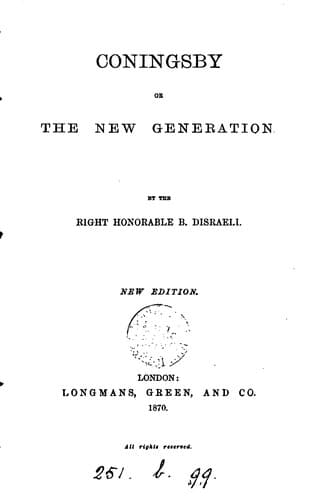
Coningsby; Or, The New GenerationDisraeli, Benjamin, Earl of Beaconsfield
General
Coningsby; Or, The New Generation
Disraeli, Benjamin, Earl of Beaconsfield
Great Britain -- Fiction; Political fiction; Politicians -- Fiction
‘Now, now, you are unkind. Your Ladyship mistakes my position. I am
interfering in this business for your sake. I might have refused the
office. It would have fallen to another, who would have fulfilled
it without any delicacy and consideration for your feelings. View my
interposition in that light, my dear Lady Monmouth, and circumstances
will assume altogether a new colour.’
‘I beg that you will quit the house, sir.’
Mr. Rigby shook his head. ‘I would with pleasure, to oblige you, were
it in my power; but Lord Monmouth has particularly desired that I should
take up my residence here permanently. The servants are now my servants.
It is useless to ring the bell. For your Ladyship’s sake, I wish
everything to be accomplished with tranquillity, and, if possible,
friendliness and good feeling. You can have even a week for the
preparations for your departure, if necessary. I will take that upon
myself. Any carriages, too, that you desire; your jewels, at least all
those that are not at the bankers’. The arrangement about your jointure,
your letters of credit, even your passport, I will attend to myself;
only too happy if, by this painful interference, I have in any way
contributed to soften the annoyance which, at the first blush, you may
naturally experience, but which, like everything else, take my word,
will wear off.’
‘I shall send for Lord Eskdale,’ said Lady Monmouth. ‘He is a
gentleman.’
‘I am quite sure,’ said Mr. Rigby, ‘that Lord Eskdale will give you the
same advice as myself, if he only reads your Ladyship’s letters,’ he
added slowly, ‘to Prince Trautsmansdorff.’
‘My letters?’ said Lady Monmouth.
‘Pardon me,’ said Rigby, putting his hand in his pocket, as if to guard
some treasure, ‘I have no wish to revive painful associations; but I
have them, and I must act upon them, if you persist in treating me as
a foe, who am in reality your best friend; which indeed I ought to be,
having the honour of acting as trustee under your marriage settlement,
and having known you so many years.’
‘Leave me for the present alone,’ said Lady Monmouth. ‘Send me my
servant, if I have one. I shall not remain here the week which you
mention, but quit at once this house, which I wish I had never entered.
Adieu! Mr. Rigby, you are now lord of Monmouth House, and yet I cannot
help feeling you too will be discharged before he dies.’
Mr. Rigby made Lady Monmouth a bow such as became the master of the
house, and then withdrew.
CHAPTER VII.
Public-domain text, read in full here on John Shaqi.
Reviews
Reviews
No reviews yet
Be the first to share your thoughts on this work.
Elsewhere in the archive
Join the Discussion
Join the discussion
Sign in to leave a comment or review.
Sign InorCreate an account