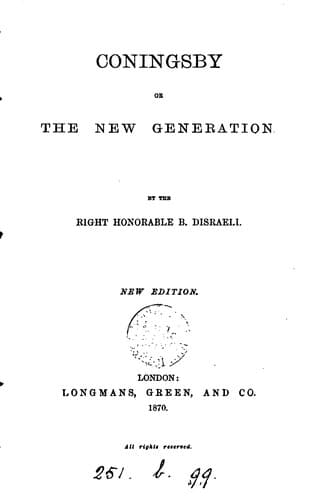
Coningsby; Or, The New GenerationDisraeli, Benjamin, Earl of Beaconsfield
General
Coningsby; Or, The New Generation
Disraeli, Benjamin, Earl of Beaconsfield
Great Britain -- Fiction; Political fiction; Politicians -- Fiction
‘Quite amicable,’ said Mr. Rigby. ‘I would never have consented to
interfere in the affair, but to secure that most desirable point.’
‘I will see Lord Monmouth at once,’ said Lucretia, rising, her natural
pallor aggravated into a ghoul-like tint.
‘His Lordship has gone out,’ said Mr. Rigby, rather stubbornly.
‘Our conversation, sir, then finishes; I wait his return.’ She bowed
haughtily.
‘His Lordship will never return to Monmouth House again.’
Lucretia sprang from the sofa.
‘Miserable craven!’ she exclaimed. ‘Has the cowardly tyrant fled? And
he really thinks that I am to be crushed by such an instrument as this!
Pah! He may leave Monmouth House, but I shall not. Begone, sir!’
‘Still anxious to secure an amicable separation,’ said Mr. Rigby, ‘your
Ladyship must allow me to place the circumstances of the case fairly
before your excellent judgment. Lord Monmouth has decided upon a course:
you know as well as I that he never swerves from his resolutions. He has
left peremptory instructions, and he will listen to no appeal. He has
empowered me to represent to your Ladyship that he wishes in every way
to consider your convenience. He suggests that everything, in short,
should be arranged as if his Lordship were himself unhappily no more;
that your Ladyship should at once enter into your jointure, which
shall be made payable quarterly to your order, provided you can find
it convenient to live upon the Continent,’ added Mr. Rigby, with some
hesitation.
‘And suppose I cannot?’
‘Why, then, we will leave your Ladyship to the assertion of your
rights.’
‘We!’
‘I beg your Ladyship’s pardon. I speak as the friend of the family, the
trustee of your marriage settlement, well known also as Lord Monmouth’s
executor,’ said Mr. Rigby, his countenance gradually regaining its
usual callous confidence, and some degree of self-complacency, as he
remembered the good things which he enumerated.
‘I have decided,’ said Lady Monmouth. ‘I will assert my rights. Your
master has mistaken my character and his own position. He shall rue the
day that he assailed me.’
‘I should be sorry if there were any violence,’ said Mr. Rigby,
‘especially as everything is left to my management and control. An
office, indeed, which I only accepted for your mutual advantage.
I think, upon reflection, I might put before your Ladyship some
considerations which might induce you, on the whole, to be of opinion
that it will be better for us to draw together in this business, as we
have hitherto, indeed, throughout an acquaintance now of some years.’
Rigby was assuming all his usual tone of brazen familiarity.
‘Your self-confidence exceeds even Lord Monmouth’s estimate of it,’ said
Lucretia.
Public-domain text, read in full here on John Shaqi.
Reviews
Reviews
No reviews yet
Be the first to share your thoughts on this work.
Elsewhere in the archive
Join the Discussion
Join the discussion
Sign in to leave a comment or review.
Sign InorCreate an account