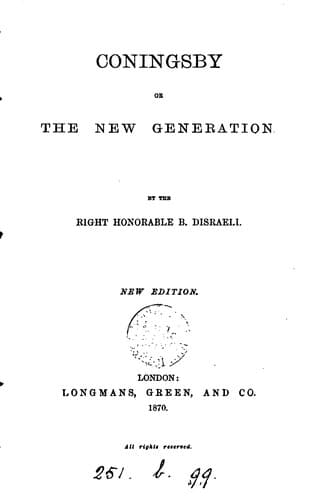
Coningsby; Or, The New GenerationDisraeli, Benjamin, Earl of Beaconsfield
General
Coningsby; Or, The New Generation
Disraeli, Benjamin, Earl of Beaconsfield
Great Britain -- Fiction; Political fiction; Politicians -- Fiction
At this moment there entered the room a little boy, the scion of a noble
house, bearing a roasted goose, which he had carried from the kitchen of
the opposite inn, the Christopher. The lower boy or fag, depositing
his burthen, asked his master whether he had further need of him; and
Buckhurst, after looking round the table, and ascertaining that he had
not, gave him permission to retire; but he had scarcely disappeared,
when his master singing out, ‘Lower boy, St. John!’ he immediately
re-entered, and demanded his master’s pleasure, which was, that he
should pour some water in the teapot. This being accomplished, St. John
really made his escape, and retired to a pupil-room, where the bullying
of a tutor, because he had no derivations, exceeded in all probability
the bullying of his master, had he contrived in his passage from the
Christopher to have upset the goose or dropped the sausages.
In their merry meal, the Reform Bill was forgotten. Their thoughts were
soon concentrated in their little world, though it must be owned that
visions of palaces and beautiful ladies did occasionally flit over the
brain of one of the company. But for him especially there was much of
interest and novelty. So much had happened in his absence! There was a
week’s arrears for him of Eton annals. They were recounted in so fresh
a spirit, and in such vivid colours, that Coningsby lost nothing by his
London visit. All the bold feats that had been done, and all the bright
things that had been said; all the triumphs, and all the failures,
and all the scrapes; how popular one master had made himself, and how
ridiculous another; all was detailed with a liveliness, a candour, and
a picturesque ingenuousness, which would have made the fortune of a
Herodotus or a Froissart.
‘I’ll tell you what,’ said Buckhurst, ‘I move that after twelve we five
go up to Maidenhead.’
‘Agreed; agreed!’
CHAPTER IX.
Millbank was the son of one of the wealthiest manufacturers in
Lancashire. His father, whose opinions were of a very democratic bent,
sent his son to Eton, though he disapproved of the system of education
pursued there, to show that he had as much right to do so as any duke in
the land. He had, however, brought up his only boy with a due prejudice
against every sentiment or institution of an aristocratic character,
and had especially impressed upon him in his school career, to avoid the
slightest semblance of courting the affections or society of any member
of the falsely-held superior class.
Public-domain text, read in full here on John Shaqi.
Reviews
Reviews
No reviews yet
Be the first to share your thoughts on this work.
Join the Discussion
Join the discussion
Sign in to leave a comment or review.
Sign InorCreate an account