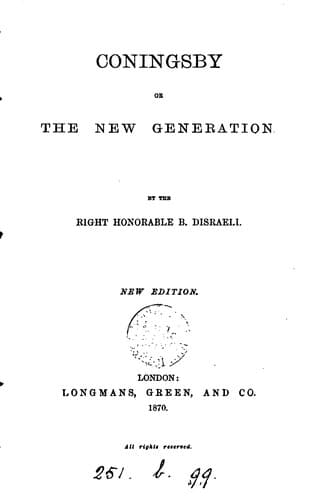
Coningsby; Or, The New GenerationDisraeli, Benjamin, Earl of Beaconsfield
General
Coningsby; Or, The New Generation
Disraeli, Benjamin, Earl of Beaconsfield
Great Britain -- Fiction; Political fiction; Politicians -- Fiction
A brother of Henry Sydney, quartered in Lancashire, had been wounded
recently in a riot, and had received great kindness from the Millbank
family, in whose immediate neighbourhood the disturbance had occurred.
The kind Duke had impressed on Henry Sydney to acknowledge with
cordiality to the younger Millbank at Eton, the sense which his family
entertained of these benefits; but though Henry lost neither time nor
opportunity in obeying an injunction, which was grateful to his own
heart, he failed in cherishing, or indeed creating, any intimacy
with the object of his solicitude. A companionship with one who was
Coningsby’s relative and most familiar friend, would at the first
glance have appeared, independently of all other considerations, a most
desirable result for Millbank to accomplish. But, perhaps, this
very circumstance afforded additional reasons for the absence of all
encouragement with which he received the overtures of Lord Henry.
Millbank suspected that Coningsby was not affected in his favour, and
his pride recoiled from gaining, by any indirect means, an intimacy
which to have obtained in a plain and express manner would have deeply
gratified him. However, the urgent invitation of Buckhurst and
Henry Sydney, and the fear that a persistence in refusal might be
misinterpreted into churlishness, had at length brought Millbank to
their breakfast-mess, though, when he accepted their invitation, he did
not apprehend that Coningsby would have been present.
It was about an hour before sunset, the day of this very breakfast, and
a good number of boys, in lounging groups, were collected in the
Long Walk. The sports and matches of the day were over. Criticism had
succeeded to action in sculling and in cricket. They talked over the
exploits of the morning; canvassed the merits of the competitors, marked
the fellow whose play or whose stroke was improving; glanced at another,
whose promise had not been fulfilled; discussed the pretensions, and
adjudged the palm. Thus public opinion is formed. Some, too, might
be seen with their books and exercises, intent on the inevitable
and impending tasks. Among these, some unhappy wight in the remove,
wandering about with his hat, after parochial fashion, seeking relief
in the shape of a verse. A hard lot this, to know that you must be
delivered of fourteen verses at least in the twenty-four hours, and to
be conscious that you are pregnant of none. The lesser boys, urchins of
tender years, clustered like flies round the baskets of certain vendors
of sugary delicacies that rested on the Long Walk wall. The pallid
countenance, the lacklustre eye, the hoarse voice clogged with
accumulated phlegm, indicated too surely the irreclaimable and hopeless
votary of lollypop, the opium-eater of schoolboys.
‘It is settled, the match to-morrow shall be between Aquatics and
Drybobs,’ said a senior boy; who was arranging a future match at
cricket.
Public-domain text, read in full here on John Shaqi.
Reviews
Reviews
No reviews yet
Be the first to share your thoughts on this work.
Join the Discussion
Join the discussion
Sign in to leave a comment or review.
Sign InorCreate an account