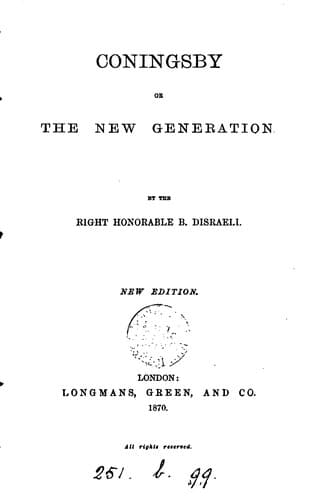
Coningsby; Or, The New GenerationDisraeli, Benjamin, Earl of Beaconsfield
General
Coningsby; Or, The New Generation
Disraeli, Benjamin, Earl of Beaconsfield
Great Britain -- Fiction; Political fiction; Politicians -- Fiction
On this day the Captain of Eton appears in a dress as martial as his
title: indeed, each sixth-form boy represents in his uniform, though not
perhaps according to the exact rules of the Horse Guards, an officer of
the army. One is a marshal, another an ensign. There is a lieutenant,
too; and the remainder are sergeants. Each of those who are intrusted
with these ephemeral commissions has one or more attendants, the number
of these varying according to his rank. These servitors are selected
according to the wishes of the several members of the sixth form, out of
the ranks of the lower boys, that is, those boys who are below the
fifth form; and all these attendants are arrayed in a variety of fancy
dresses. The Captain of the Oppidans and the senior Colleger next to
the Captain of the school, figure also in fancy costume, and are called
‘Saltbearers.’ It is their business, together with the twelve senior
Collegers of the fifth form, who are called ‘Runners,’ and whose
costume is also determined by the taste of the wearers, to levy the
contributions. And all the Oppidans of the fifth form, among whom ranked
Coningsby, class as ‘Corporals;’ and are severally followed by one or
more lower boys, who are denominated ‘Polemen,’ but who appear in their
ordinary dress.
It was a fine, bright morning; the bells of Eton and Windsor rang
merrily; everybody was astir, and every moment some gay equipage
drove into the town. Gaily clustering in the thronged precincts of
the College, might be observed many a glistening form: airy Greek or
sumptuous Ottoman, heroes of the Holy Sepulchre, Spanish Hidalgos who
had fought at Pavia, Highland Chiefs who had charged at Culloden, gay in
the tartan of Prince Charlie. The Long Walk was full of busy groups in
scarlet coats or fanciful uniforms; some in earnest conversation, some
criticising the arriving guests; others encircling some magnificent
hero, who astounded them with his slashed doublet or flowing plume.
A knot of boys, sitting on the Long Walk wall, with their feet swinging
in the air, watched the arriving guests of the Provost.
‘I say, Townshend,’ said one, ‘there’s Grobbleton; he _was_ a bully. I
wonder if that’s his wife? Who’s this? The Duke of Agincourt. He wasn’t
an Eton fellow? Yes, he was. He was called Poictiers then. Oh! ah!
his name is in the upper school, very large, under Charles Fox. I say,
Townshend, did you see Saville’s turban? What was it made of? He says
his mother brought it from Grand Cairo. Didn’t he just look like the
Saracen’s Head? Here are some Dons. That’s Hallam! We’ll give him a
cheer. I say, Townshend, look at this fellow. He doesn’t think small
beer of himself. I wonder who he is? The Duke of Wellington’s valet come
to say his master is engaged. Oh! by Jove, he heard you! I wonder if the
Duke will come? Won’t we give him a cheer!’
‘By Jove! who is this?’ exclaimed Townshend, and he jumped from the
wall, and, followed by his companions, rushed towards the road.
Public-domain text, read in full here on John Shaqi.
Reviews
Reviews
No reviews yet
Be the first to share your thoughts on this work.
Join the Discussion
Join the discussion
Sign in to leave a comment or review.
Sign InorCreate an account