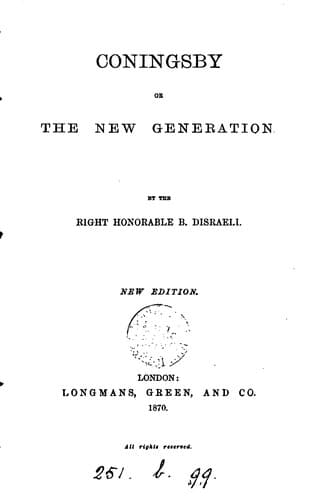
Coningsby; Or, The New GenerationDisraeli, Benjamin, Earl of Beaconsfield
General
Coningsby; Or, The New Generation
Disraeli, Benjamin, Earl of Beaconsfield
Great Britain -- Fiction; Political fiction; Politicians -- Fiction
one might form some faint idea of this gracious personage.
The eldest son of this house was now on the continent; of his
two younger brothers, one was with his regiment and the other was
Coningsby’s friend at Eton, our Henry Sydney. The two eldest daughters
had just married, on the same day, and at the same altar; and the
remaining one, Theresa, was still a child.
The Duke had occupied a chief post in the Household under the late
administration, and his present guests chiefly consisted of his former
colleagues in office. There were several members of the late cabinet,
several members for his Grace’s late boroughs, looking very much like
martyrs, full of suffering and of hope. Mr. Tadpole and Mr. Taper were
also there; they too had lost their seats since 1832; but being men of
business, and accustomed from early life to look about them, they had
already commenced the combinations which on a future occasion were to
bear them back to the assembly where they were so missed.
Taper had his eye on a small constituency which had escaped the fatal
schedules, and where he had what they called a ‘connection;’ that is to
say, a section of the suffrages who had a lively remembrance of Treasury
favours once bestowed by Mr. Taper, and who had not been so liberally
dealt with by the existing powers. This connection of Taper was in time
to leaven the whole mass of the constituent body, and make it rise in
full rebellion against its present liberal representative, who being
one of a majority of three hundred, could get nothing when he called at
Whitehall or Downing Street.
Tadpole, on the contrary, who was of a larger grasp of mind than
Taper, with more of imagination and device but not so safe a man, was
coquetting with a manufacturing town and a large constituency, where he
was to succeed by the aid of the Wesleyans, of which pious body he had
suddenly become a fervent admirer. The great Mr. Rigby, too, was a guest
out of Parliament, nor caring to be in; but hearing that his friends had
some hopes, he thought he would just come down to dash them.
The political grapes were sour for Mr. Rigby; a prophet of evil, he
preached only mortification and repentance and despair to his late
colleagues. It was the only satisfaction left Mr. Rigby, except assuring
the Duke that the finest pictures in his gallery were copies, and
recommending him to pull down Beaumanoir, and rebuild it on a design
with which Mr. Rigby would furnish him.
The battue and the banquet were over; the ladies had withdrawn; and the
butler placed fresh claret on the table.
‘And you really think you could give us a majority, Tadpole?’ said the
Duke.
Mr. Tadpole, with some ceremony, took a memorandum-book out of his
pocket, amid the smiles and the faint well-bred merriment of his
friends.
‘Tadpole is nothing without his book,’ whispered Lord Fitz-Booby.
‘It is here,’ said Mr. Tadpole, emphatically patting his volume, ‘a
clear working majority of twenty-two.’
Public-domain text, read in full here on John Shaqi.
Reviews
Reviews
No reviews yet
Be the first to share your thoughts on this work.
Elsewhere in the archive
Join the Discussion
Join the discussion
Sign in to leave a comment or review.
Sign InorCreate an account