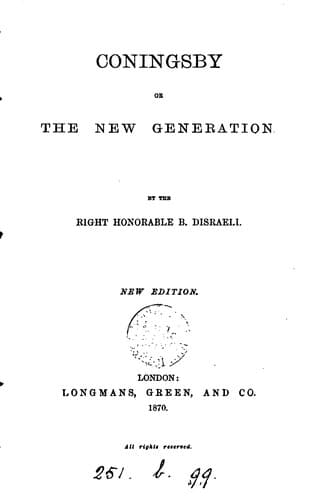
Coningsby; Or, The New GenerationDisraeli, Benjamin, Earl of Beaconsfield
General
Coningsby; Or, The New Generation
Disraeli, Benjamin, Earl of Beaconsfield
Great Britain -- Fiction; Political fiction; Politicians -- Fiction
On the evening of the 15th of November, a despatch arrived at
Beaumanoir, informing his Grace that the King had dismissed the Whig
Ministry, and sent for the Duke of Wellington. Thus the first agitating
suspense was over; to be succeeded, however, by expectation still more
anxious. It was remarkable that every individual suddenly found that he
had particular business in London which could not be neglected. The Duke
very properly pleaded his executorial duties; but begged his guests on
no account to be disturbed by his inevitable absence. Lord Fitz-Booby
had just received a letter from his daughter, who was indisposed at
Brighton, and he was most anxious to reach her. Tadpole had to receive
deputations from Wesleyans, and well-registered boroughs anxious to
receive well-principled candidates. Taper was off to get the first job
at the contingent Treasury, in favour of the Borough of Shabbyton.
Mr. Rigby alone was silent; but he quietly ordered a post-chaise at
daybreak, and long before his fellow guests were roused from their
slumbers, he was halfway to London, ready to give advice, either at the
pavilion or at Apsley House.
CHAPTER IV.
Although it is far from improbable that, had Sir Robert Peel been in
England in the autumn of 1834, the Whig government would not have been
dismissed; nevertheless, whatever may now be the opinion of the policy
of that measure; whether it be looked on as a premature movement which
necessarily led to the compact reorganisation of the Liberal party,
or as a great stroke of State, which, by securing at all events a
dissolution of the Parliament of 1832, restored the healthy balance of
parties in the Legislature, questions into which we do not now wish
to enter, it must be generally admitted, that the conduct of every
individual eminently concerned in that great historical transaction was
characterised by the rarest and most admirable quality of public
life, moral courage. The Sovereign who dismissed a Ministry apparently
supported by an overwhelming majority in the Parliament and the nation,
and called to his councils the absent chief of a parliamentary section,
scarcely numbering at that moment one hundred and forty individuals, and
of a party in the country supposed to be utterly discomfited by a
recent revolution; the two ministers who in this absence provisionally
administered the affairs of the kingdom in the teeth of an enraged
and unscrupulous Opposition, and perhaps themselves not sustained by
a profound conviction, that the arrival of their expected leader would
convert their provisional into a permanent position; above all
the statesman who accepted the great charge at a time and under
circumstances which marred probably the deep projects of his own
prescient sagacity and maturing ambition; were all men gifted with a
high spirit of enterprise, and animated by that active fortitude which
is the soul of free governments.
Public-domain text, read in full here on John Shaqi.
Reviews
Reviews
No reviews yet
Be the first to share your thoughts on this work.
Elsewhere in the archive
Join the Discussion
Join the discussion
Sign in to leave a comment or review.
Sign InorCreate an account