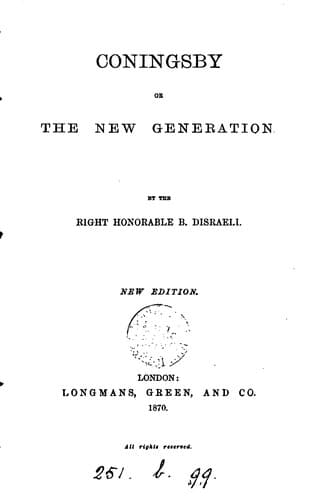
Coningsby; Or, The New GenerationDisraeli, Benjamin, Earl of Beaconsfield
General
Coningsby; Or, The New Generation
Disraeli, Benjamin, Earl of Beaconsfield
Great Britain -- Fiction; Political fiction; Politicians -- Fiction
It was a lively season, that winter of 1834! What hopes, what fears, and
what bets! From the day on which Mr. Hudson was to arrive at Rome to the
election of the Speaker, not a contingency that was not the subject of
a wager! People sprang up like mushrooms; town suddenly became full.
Everybody who had been in office, and everybody who wished to be in
office; everybody who had ever had anything, and everybody who ever
expected to have anything, were alike visible. All of course by mere
accident; one might meet the same men regularly every day for a month,
who were only ‘passing through town.’
Now was the time for men to come forward who had never despaired of
their country. True they had voted for the Reform Bill, but that was to
prevent a revolution. And now they were quite ready to vote against the
Reform Bill, but this was to prevent a dissolution. These are the true
patriots, whose confidence in the good sense of their countrymen and in
their own selfishness is about equal. In the meantime, the hundred and
forty threw a grim glance on the numerous waiters on Providence, and
amiable trimmers, who affectionately enquired every day when news might
be expected of Sir Robert. Though too weak to form a government, and
having contributed in no wise by their exertions to the fall of the
late, the cohort of Parliamentary Tories felt all the alarm of men who
have accidentally stumbled on some treasure-trove, at the suspicious
sympathy of new allies. But, after all, who were to form the government,
and what was the government to be? Was it to be a Tory government, or an
Enlightened-Spirit-of-the-Age Liberal-Moderate-Reform government; was it
to be a government of high philosophy or of low practice; of principle
or of expediency; of great measures or of little men? A government of
statesmen or of clerks? Of Humbug or of Humdrum? Great questions these,
but unfortunately there was nobody to answer them. They tried the Duke;
but nothing could be pumped out of him. All that he knew, which he
told in his curt, husky manner, was, that he had to carry on the King’s
government. As for his solitary colleague, he listened and smiled, and
then in his musical voice asked them questions in return, which is the
best possible mode of avoiding awkward inquiries. It was very unfair
this; for no one knew what tone to take; whether they should go down to
their public dinners and denounce the Reform Act or praise it; whether
the Church was to be re-modelled or only admonished; whether Ireland was
to be conquered or conciliated.
‘This can’t go on much longer,’ said Taper to Tadpole, as they reviewed
together their electioneering correspondence on the 1st of December; ‘we
have no cry.’
‘He is half way by this time,’ said Tadpole; ‘send an extract from a
private letter to the _Standard_, dated Augsburg, and say he will be
here in four days.’
Public-domain text, read in full here on John Shaqi.
Reviews
Reviews
No reviews yet
Be the first to share your thoughts on this work.
Elsewhere in the archive
Join the Discussion
Join the discussion
Sign in to leave a comment or review.
Sign InorCreate an account