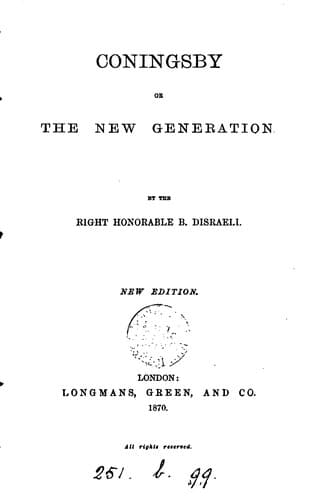
Coningsby; Or, The New GenerationDisraeli, Benjamin, Earl of Beaconsfield
General
Coningsby; Or, The New Generation
Disraeli, Benjamin, Earl of Beaconsfield
Great Britain -- Fiction; Political fiction; Politicians -- Fiction
In the meantime, while forms and phrases are religiously cherished in
order to make the semblance of a creed, the rule of practice is to
bend to the passion or combination of the hour. Conservatism assumes in
theory that everything established should be maintained; but adopts
in practice that everything that is established is indefensible. To
reconcile this theory and this practice, they produce what they call
‘the best bargain;’ some arrangement which has no principle and no
purpose, except to obtain a temporary lull of agitation, until the mind
of the Conservatives, without a guide and without an aim, distracted,
tempted, and bewildered, is prepared for another arrangement, equally
statesmanlike with the preceding one.
Conservatism was an attempt to carry on affairs by substituting the
fulfilment of the duties of office for the performance of the functions
of government; and to maintain this negative system by the mere
influence of property, reputable private conduct, and what are called
good connections. Conservatism discards Prescription, shrinks from
Principle, disavows Progress; having rejected all respect for Antiquity,
it offers no redress for the Present, and makes no preparation for the
Future. It is obvious that for a time, under favourable circumstances,
such a confederation might succeed; but it is equally clear, that on
the arrival of one of those critical conjunctures that will periodically
occur in all states, and which such an unimpassioned system is even
calculated ultimately to create, all power of resistance will be
wanting: the barren curse of political infidelity will paralyse all
action; and the Conservative Constitution will be discovered to be a
Caput Mortuum.
CHAPTER VI.
In the meantime, after dinner, Tadpole and Taper, who were among the
guests of Mr. Ormsby, withdrew to a distant sofa, out of earshot, and
indulged in confidential talk.
‘Such a strength in debate was never before found on a Treasury bench,’
said Mr. Tadpole; ‘the other side will be dumbfounded.’
‘And what do you put our numbers at now?’ inquired Mr. Taper.
‘Would you take fifty-five for our majority?’ rejoined Mr. Tadpole.
‘It is not so much the tail they have, as the excuse their junction will
be for the moderate, sensible men to come over,’ said Taper. ‘Our friend
Sir Everard for example, it would settle him.’
‘He is a solemn impostor,’ rejoined Mr. Tadpole; ‘but he is a baronet
and a county member, and very much looked up to by the Wesleyans. The
other men, I know, have refused him a peerage.’
‘And we might hold out judicious hopes,’ said Taper.
‘No one can do that better than you,’ said Tadpole. ‘I am apt to say too
much about those things.’
Public-domain text, read in full here on John Shaqi.
Reviews
Reviews
No reviews yet
Be the first to share your thoughts on this work.
Elsewhere in the archive
Join the Discussion
Join the discussion
Sign in to leave a comment or review.
Sign InorCreate an account