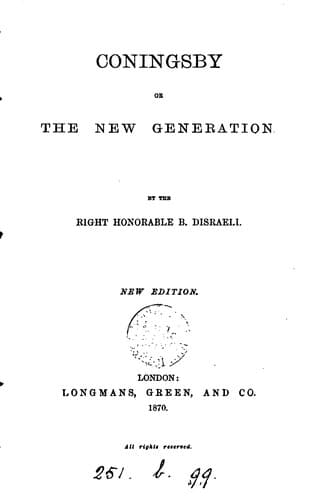
Coningsby; Or, The New GenerationDisraeli, Benjamin, Earl of Beaconsfield
General
Coningsby; Or, The New Generation
Disraeli, Benjamin, Earl of Beaconsfield
Great Britain -- Fiction; Political fiction; Politicians -- Fiction
No one had arisen either in Parliament, the Universities, or the Press,
to lead the public mind to the investigation of principles; and not
to mistake, in their reformations, the corruption of practice for
fundamental ideas. It was this perplexed, ill-informed, jaded, shallow
generation, repeating cries which they did not comprehend, and wearied
with the endless ebullitions of their own barren conceit, that Sir
Robert Peel was summoned to govern. It was from such materials, ample
in quantity, but in all spiritual qualities most deficient; with
great numbers, largely acred, consoled up to their chins, but without
knowledge, genius, thought, truth, or faith, that Sir Robert Peel was to
form a ‘great Conservative party on a comprehensive basis.’ That he
did this like a dexterous politician, who can deny? Whether he realised
those prescient views of a great statesman in which he had doubtless
indulged, and in which, though still clogged by the leadership of 1834,
he may yet find fame for himself and salvation for his country, is
altogether another question. His difficult attempt was expressed in
an address to his constituents, which now ranks among state papers.
We shall attempt briefly to consider it with the impartiality of the
future.
CHAPTER V.
The Tamworth Manifesto of 1834 was an attempt to construct a
party without principles; its basis therefore was necessarily
Latitudinarianism; and its inevitable consequence has been Political
Infidelity.
At an epoch of political perplexity and social alarm, the confederation
was convenient, and was calculated by aggregation to encourage the timid
and confused. But when the perturbation was a little subsided, and
men began to inquire why they were banded together, the difficulty of
defining their purpose proved that the league, however respectable, was
not a party. The leaders indeed might profit by their eminent position
to obtain power for their individual gratification, but it was
impossible to secure their followers that which, after all, must be the
great recompense of a political party, the putting in practice of their
opinions; for they had none.
There was indeed a considerable shouting about what they called
Conservative principles; but the awkward question naturally arose, what
will you conserve? The prerogatives of the Crown, provided they are not
exercised; the independence of the House of Lords, provided it is not
asserted; the Ecclesiastical estate, provided it is regulated by a
commission of laymen. Everything, in short, that is established, as long
as it is a phrase and not a fact.
Public-domain text, read in full here on John Shaqi.
Reviews
Reviews
No reviews yet
Be the first to share your thoughts on this work.
Elsewhere in the archive
Join the Discussion
Join the discussion
Sign in to leave a comment or review.
Sign InorCreate an account