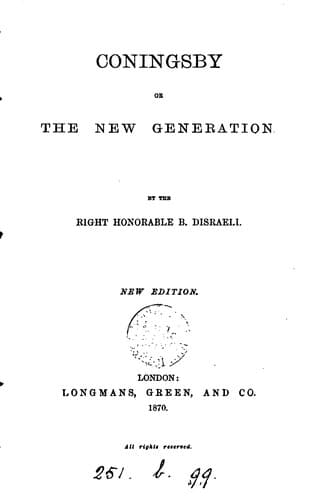
Coningsby; Or, The New GenerationDisraeli, Benjamin, Earl of Beaconsfield
General
Coningsby; Or, The New Generation
Disraeli, Benjamin, Earl of Beaconsfield
Great Britain -- Fiction; Political fiction; Politicians -- Fiction
As for the dominion of Coningsby himself, it was not limited to the
immediate circle of his friends. He had become the hero of Eton; the
being of whose existence everybody was proud, and in whose career every
boy took an interest. They talked of him, they quoted him, they imitated
him. Fame and power are the objects of all men. Even their partial
fruition is gained by very few; and that too at the expense of social
pleasure, health, conscience, life. Yet what power of manhood in
passionate intenseness, appealing at the same time to the subject and
the votary, can rival that which is exercised by the idolised chieftain
of a great public school? What fame of after days equals the rapture of
celebrity that thrills the youthful poet, as in tones of rare emotion he
recites his triumphant verses amid the devoted plaudits of the flower
of England? That’s fame, that’s power; real, unquestioned, undoubted,
catholic. Alas! the schoolboy, when he becomes a man, finds that power,
even fame, like everything else, is an affair of party.
Coningsby liked very much to talk politics with Millbank. He heard
things from Millbank which were new to him. Himself, as he supposed, a
high Tory, which he was according to the revelation of the Rigbys, he
was also sufficiently familiar with the hereditary tenets of his Whig
friend, Lord Vere. Politics had as yet appeared to him a struggle
whether the country was to be governed by Whig nobles or Tory nobles;
and he thought it very unfortunate that he should probably have to enter
life with his friends out of power, and his family boroughs destroyed.
But in conversing with Millbank, he heard for the first time of
influential classes in the country who were not noble, and were yet
determined to acquire power. And although Millbank’s views, which were
of course merely caught up from his father, without the intervention of
his own intelligence, were doubtless crude enough, and were often very
acutely canvassed and satisfactorily demolished by the clever prejudices
of another school, which Coningsby had at command, still they were,
unconsciously to the recipient, materials for thought, and insensibly
provoked in his mind a spirit of inquiry into political questions, for
which he had a predisposition.
Public-domain text, read in full here on John Shaqi.
Reviews
Reviews
No reviews yet
Be the first to share your thoughts on this work.
Elsewhere in the archive
Join the Discussion
Join the discussion
Sign in to leave a comment or review.
Sign InorCreate an account