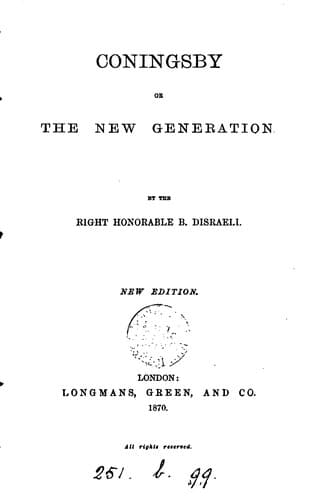
Coningsby; Or, The New GenerationDisraeli, Benjamin, Earl of Beaconsfield
General
Coningsby; Or, The New Generation
Disraeli, Benjamin, Earl of Beaconsfield
Great Britain -- Fiction; Political fiction; Politicians -- Fiction
It may be said, indeed, that generally among the upper boys there might
be observed at this time, at Eton, a reigning inclination for political
discussion. The school truly had at all times been proud of its
statesmen and its parliamentary heroes, but this was merely a
superficial feeling in comparison with the sentiment which now first
became prevalent. The great public questions that were the consequence
of the Reform of the House of Commons, had also agitated their young
hearts. And especially the controversies that were now rife respecting
the nature and character of ecclesiastical establishments, wonderfully
addressed themselves to their excited intelligence. They read their
newspapers with a keen relish, canvassed debates, and criticised
speeches; and although in their debating society, which had been
instituted more than a quarter of a century, discussion on topics of
the day was prohibited, still by fixing on periods of our history when
affairs were analogous to the present, many a youthful orator contrived
very effectively to reply to Lord John, or to refute the fallacies of
his rival.
As the political opinions predominant in the school were what in
ordinary parlance are styled Tory, and indeed were far better entitled
to that glorious epithet than the flimsy shifts which their fathers were
professing in Parliament and the country; the formation and the fall
of Sir Robert Peel’s government had been watched by Etonians with great
interest, and even excitement. The memorable efforts which the Minister
himself made, supported only by the silent votes of his numerous
adherents, and contending alone against the multiplied assaults of his
able and determined foes, with a spirit equal to the great occasion, and
with resources of parliamentary contest which seemed to increase
with every exigency; these great and unsupported struggles alone were
calculated to gain the sympathy of youthful and generous spirits. The
assault on the revenues of the Church; the subsequent crusade against
the House of Lords; the display of intellect and courage exhibited
by Lord Lyndhurst in that assembly, when all seemed cowed and
faint-hearted; all these were incidents or personal traits apt to stir
the passions, and create in breasts not yet schooled to repress emotion,
a sentiment even of enthusiasm. It is the personal that interests
mankind, that fires their imagination, and wins their hearts. A cause is
a great abstraction, and fit only for students; embodied in a party, it
stirs men to action; but place at the head of that party a leader who
can inspire enthusiasm, he commands the world. Divine faculty! Rare and
incomparable privilege! A parliamentary leader who possesses it, doubles
his majority; and he who has it not, may shroud himself in artificial
reserve, and study with undignified arrogance an awkward haughtiness,
but he will nevertheless be as far from controlling the spirit as from
captivating the hearts of his sullen followers.
Public-domain text, read in full here on John Shaqi.
Reviews
Reviews
No reviews yet
Be the first to share your thoughts on this work.
Elsewhere in the archive
Join the Discussion
Join the discussion
Sign in to leave a comment or review.
Sign InorCreate an account