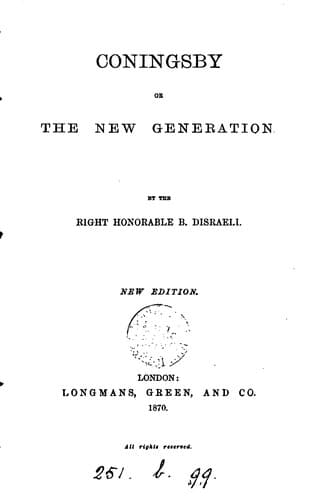
Coningsby; Or, The New GenerationDisraeli, Benjamin, Earl of Beaconsfield
General
Coningsby; Or, The New Generation
Disraeli, Benjamin, Earl of Beaconsfield
Great Britain -- Fiction; Political fiction; Politicians -- Fiction
‘But Ceres without Bacchus,’ said Coningsby, ‘how does that do? Think
you, under this roof, we could Invoke the god?’
‘Let us swear by his body that we will try,’ said the stranger.
Alas! the landlord was not a priest to Bacchus. But then these inquiries
led to the finest perry in the world. The young men agreed they had
seldom tasted anything more delicious; they sent for another bottle.
Coningsby, who was much interested by his new companion, enjoyed himself
amazingly.
A cheese, such as Derby alone can produce, could not induce the stranger
to be even partially inconstant to his crusts. But his talk was as
vivacious as if the talker had been stimulated by the juices of the
finest banquet. Coningsby had never met or read of any one like this
chance companion. His sentences were so short, his language so racy, his
voice rang so clear, his elocution was so complete. On all subjects his
mind seemed to be instructed, and his opinions formed. He flung out a
result in a few words; he solved with a phrase some deep problem that
men muse over for years. He said many things that were strange, yet
they immediately appeared to be true. Then, without the slightest air of
pretension or parade, he seemed to know everybody as well as everything.
Monarchs, statesmen, authors, adventurers, of all descriptions and of
all climes, if their names occurred in the conversation, he described
them in an epigrammatic sentence, or revealed their precise position,
character, calibre, by a curt dramatic trait. All this, too, without any
excitement of manner; on the contrary, with repose amounting almost
to nonchalance. If his address had any fault in it, it was rather a
deficiency of earnestness. A slight spirit of mockery played over his
speech even when you deemed him most serious; you were startled by his
sudden transitions from profound thought to poignant sarcasm. A very
singular freedom from passion and prejudice on every topic on which
they treated, might be some compensation for this want of earnestness,
perhaps was its consequence. Certainly it was difficult to ascertain his
precise opinions on many subjects, though his manner was frank even to
abandonment. And yet throughout his whole conversation, not a stroke of
egotism, not a word, not a circumstance escaped him, by which you could
judge of his position or purposes in life. As little did he seem to care
to discover those of his companion. He did not by any means monopolise
the conversation. Far from it; he continually asked questions, and
while he received answers, or had engaged his fellow-traveller in any
exposition of his opinion or feelings, he listened with a serious and
fixed attention, looking Coningsby in the face with a steadfast glance.
‘I perceive,’ said Coningsby, pursuing a strain of thought which the
other had indicated, ‘that you have great confidence in the influence
of individual character. I also have some confused persuasions of that
kind. But it is not the Spirit of the Age.’
Public-domain text, read in full here on John Shaqi.
Reviews
Reviews
No reviews yet
Be the first to share your thoughts on this work.
Elsewhere in the archive
Join the Discussion
Join the discussion
Sign in to leave a comment or review.
Sign InorCreate an account