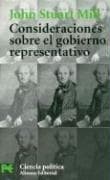
Considerations on Representative GovernmentMill, John Stuart
PhilosophyPhilosophy
Considerations on Representative Government
Mill, John Stuart
Representative government and representation
"Exactly in proportion as the vote of the elector is determined by his
own will, and not by that of somebody who is his master, his position
is similar to that of a member of Parliament, and publicity is
indispensable. So long as any portion of the community are
unrepresented, the argument of the Chartists against ballot in
conjunction with a restricted suffrage is unassailable. The present
electors, and the bulk of those whom any probable Reform Bill would
add to the number, are the middle class, and have as much a class
interest, distinct from the working classes, as landlords or great
manufacturers. Were the suffrage extended to all skilled laborers,
even these would, or might, still have a class interest distinct from
the unskilled. Suppose it extended to all men--suppose that what was
formerly called by the misapplied name of universal suffrage, and now
by the silly title of manhood suffrage, became the law; the voters
would still have a class interest as distinguished from women. Suppose
that there were a question before the Legislature specially affecting
women--as whether women should be allowed to graduate at universities;
whether the mild penalties inflicted on ruffians who beat their wives
daily almost to death's door should be exchanged for something more
effectual; or suppose that any one should propose in the British
Parliament what one state after another in America is enacting, not by
a mere law, but by a provision of their revised Constitutions; that
married women should have a right to their own property--are not a
man's wife and daughters entitled to know whether he votes for or
against a candidate who will support these propositions?
"It will of course be objected that these arguments' derive all their
weight from the supposition of an unjust state of the suffrage: that
if the opinion of the non-electors is likely to make the elector vote
more honestly or more beneficially than he would vote if left to
himself, they are more fit to be electors than he is, and ought to
have the franchise; that whoever is fit to influence electors is fit
to be an elector; that those to whom voters ought to be responsible
should be themselves voters, and, being such, should have the
safeguard of the ballot, to shield them from the undue influence of
powerful individuals or classes to whom they ought not to be
responsible.
Public-domain text, read in full here on John Shaqi.
Reviews
Reviews
No reviews yet
Be the first to share your thoughts on this work.
Elsewhere in the archive
Join the Discussion
Join the discussion
Sign in to leave a comment or review.
Sign InorCreate an account