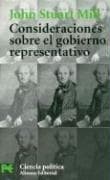
Considerations on Representative GovernmentMill, John Stuart
PhilosophyPhilosophy
Considerations on Representative Government
Mill, John Stuart
Representative government and representation
"This argument is specious, and I once thought it conclusive. It now
appears to me fallacious. All who are fit to influence electors are
not, for that reason, fit to be themselves electors. This last is a
much greater power than the former, and those may be ripe for the
minor political function who could not as yet be safely trusted with
the superior. The opinions and wishes of the poorest and rudest class
of laborers may be very useful as one influence among others on the
minds of the voters, as well as on those of the Legislature, and yet
it might be highly mischievous to give them the preponderant
influence, by admitting them, in their present state of morals and
intelligence, to the full exercise of the suffrage. It is precisely
this indirect influence of those who have not the suffrage over those
who have, which, by its progressive growth, softens the transition to
every fresh extension of the franchise, and is the means by which,
when the time is ripe, the extension is peacefully brought about. But
there is another and a still deeper consideration, which should never
be left out of the account in political speculations. The notion is
itself unfounded that publicity, and the sense of being answerable to
the public, are of no use unless the public are qualified to form a
sound judgment. It is a very superficial view of the utility of public
opinion to suppose that it does good only when it succeeds in
enforcing a servile conformity to itself. To be under the eyes of
others--to have to defend oneself to others--is never more important
than to those who act in opposition to the opinion of others, for it
obliges them to have sure ground of their own. Nothing has so
steadying an influence as working against pressure. Unless when under
the temporary sway of passionate excitement, no one will do that which
he expects to be greatly blamed for, unless from a preconceived and
fixed purpose of his own, which is always evidence of a thoughtful and
deliberate character, and, except in radically bad men, generally
proceeds from sincere and strong personal convictions. Even the bare
fact of having to give an account of their conduct is a powerful
inducement to adhere to conduct of which at least some decent account
can be given. If any one thinks that the mere obligation of preserving
decency is not a very considerable check on the abuse of power, he has
never had his attention called to the conduct of those who do not feel
under the necessity of observing that restraint. Publicity is
inappreciable, even when it does no more than prevent that which can
by no possibility be plausibly defended--than compel deliberation, and
force every one to determine, before he acts, what he shall say if
called to account for his actions.
Public-domain text, read in full here on John Shaqi.
Reviews
Reviews
No reviews yet
Be the first to share your thoughts on this work.
Elsewhere in the archive
Join the Discussion
Join the discussion
Sign in to leave a comment or review.
Sign InorCreate an account