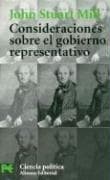
Considerations on Representative GovernmentMill, John Stuart
PhilosophyPhilosophy
Considerations on Representative Government
Mill, John Stuart
Representative government and representation
"But, if not now (it may be said), at least hereafter, when all are
fit to have votes, and when all men and women are admitted to vote in
virtue of their fitness, _then_ there can no longer be danger of class
legislation; then the electors, being the nation, can have no interest
apart from the general interest: even if individuals still vote
according to private or class inducements, the majority will have no
such inducement; and as there will then be no non-electors to whom
they ought to be responsible, the effect of the ballot, excluding none
but the sinister influences, will be wholly beneficial.
"Even in this I do not agree. I can not think that even if the people
were fit for, and had obtained universal suffrage, the ballot would be
desirable. First, because it could not, in such circumstances, be
supposed to be needful. Let us only conceive the state of things which
the hypothesis implies: a people universally educated, and every
grown-up human being possessed of a vote. If, even when only a small
proportion are electors, and the majority of the population almost
uneducated, public opinion is already, as every one now sees that it
is, the ruling power in the last resort, it is a chimera to suppose
that over a community who all read, and who all have votes, any power
could be exercised by landlords and rich people against their own
inclination, which it would be at all difficult for them to throw off.
But, though the protection of secrecy would then be needless, the
control of publicity would be as needful as ever. The universal
observation of mankind has been very fallacious, if the mere fact of
being one of the community, and not being in a position of pronounced
contrariety of interest to the public at large, is enough to insure
the performance of a public duty, without either the stimulus or the
restraint derived from the opinion of our fellow-creatures. A man's
own particular share of the public interest, even though he may have
no private interest drawing him in the opposite direction, is not, as
a general rule, found sufficient to make him do his duty to the public
without other external inducements. Neither can it be admitted that,
even if all had votes, they would give their votes as honestly in
secret as in public.
Public-domain text, read in full here on John Shaqi.
Reviews
Reviews
No reviews yet
Be the first to share your thoughts on this work.
Elsewhere in the archive
Join the Discussion
Join the discussion
Sign in to leave a comment or review.
Sign InorCreate an account