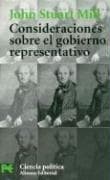
Considerations on Representative GovernmentMill, John Stuart
PhilosophyPhilosophy
Considerations on Representative Government
Mill, John Stuart
Representative government and representation
authenticated superiority of education were it only to give the tone
to public feeling, irrespective of any direct political consequences.
When there does exist in the electoral body an adequate sense of the
extraordinary difference in value between one person and another, they
will not lack signs by which to distinguish the persons whose worth
for their purposes is the greatest. Actual public services will
naturally be the foremost indication: to have filled posts of
magnitude, and done important things in them, of which the wisdom has
been justified by the results; to have been the author of measures
which appear from their effects to have been wisely planned; to have
made predictions which have been of verified by the event, seldom or
never falsified by it; to have given advice, which when taken has been
followed by good consequences--when neglected, by bad. There is
doubtless a large portion of uncertainty in these signs of wisdom; but
we are seeking for such as can be applied by persons of ordinary
discernment. They will do well not to rely much on any one indication,
unless corroborated by the rest, and, in their estimation of the
success or merit of any practical effort, to lay great stress on the
general opinion of disinterested persons conversant with the subject
matter. The tests which I have spoken of are only applicable to tried
men, among whom must be reckoned those who, though untried
practically, have been tried speculatively; who, in public speech or
in print, have discussed public affairs in a manner which proves that
they have given serious study to them. Such persons may, in the mere
character of political thinkers, have exhibited a considerable amount
of the same titles to confidence as those who have been proved in the
position of practical statesmen. When it is necessary to choose
persons wholly untried, the best criteria are, reputation for ability
among those who personally know them, and the confidence placed and
recommendations given by persons already looked up to. By tests like
these, constituencies who sufficiently value mental ability, and
eagerly seek for it, will generally succeed in obtaining men beyond
mediocrity, and often men whom they can trust to carry on public
affairs according to their unfettered judgment; to whom it would be an
affront to require that they should give up that judgment at the
behest of their inferiors in knowledge. If such persons, honestly
sought, are not to be found, then indeed the electors are justified in
taking other precautions, for they can not be expected to postpone
their particular opinions, unless in order that they may be served by
a person of superior knowledge to their own. They would do well,
indeed, even then, to remember that when once chosen, the
representative, if he devotes himself to his duty, has greater
opportunities of correcting an original false judgment than fall to
the lot of most of his constituents; a consideration which generally
Public-domain text, read in full here on John Shaqi.
Reviews
Reviews
No reviews yet
Be the first to share your thoughts on this work.
Elsewhere in the archive
Join the Discussion
Join the discussion
Sign in to leave a comment or review.
Sign InorCreate an account