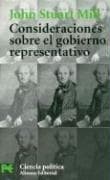
Considerations on Representative GovernmentMill, John Stuart
PhilosophyPhilosophy
Considerations on Representative Government
Mill, John Stuart
Representative government and representation
In making first appointments, little danger is to be apprehended from
want of special skill and knowledge in the choosers, but much from
partiality, and private or political interest. Being all appointed at
the commencement of manhood, not as having learned, but in order that
they may learn, their profession, the only thing by which the best
candidates can be discriminated is proficiency in the ordinary
branches of liberal education; and this can be ascertained without
difficulty, provided there be the requisite pains and the requisite
impartiality in those who are appointed to inquire into it. Neither
the one nor the other can reasonably be expected from a minister, who
must rely wholly on recommendations, and, however disinterested as to
his personal wishes, never will be proof against the solicitations of
persons who have the power of influencing his own election, or whose
political adherence is important to the ministry to which he belongs.
These considerations have introduced the practice of submitting all
candidates for first appointments to a public examination, conducted
by persons not engaged in politics, and of the same class and quality
with the examiners for honors at the Universities. This would probably
be the best plan under any system; and under our Parliamentary
government it is the only one which affords a chance, I do not say of
honest appointment, but even of abstinence from such as are manifestly
and flagrantly profligate.
It is also absolutely necessary that the examinations should be
competitive, and the appointments given to those who are most
successful. A mere pass examination never, in the long run, does more
than exclude absolute dunces. When the question, in the mind of an
examiner, lies between blighting the prospects of an individual and
performing a duty to the public which, in the particular instance,
seldom appears of first rate importance, and when he is sure to be
bitterly reproached for doing the first, while in general no one will
either know or care whether he has done the latter, the balance,
unless he is a man of very unusual stamp, inclines to the side of
good-nature. A relaxation in one instance establishes a claim to it in
others, which every repetition of indulgence makes it more difficult
to resist; each of these, in succession, becomes a precedent for more,
until the standard of proficiency sinks gradually to something almost
contemptible. Examinations for degrees at the two great Universities
have generally been as slender in their requirements as those for
honors are trying and serious. Where there is no inducement to exceed
a certain minimum, the minimum comes to be the maximum: it becomes the
general practice not to aim at more; and as in every thing there are
some who do not attain all they aim at, however low the standard may
be pitched, there are always several who fall short of it. When, on
the contrary, the appointments are given to those, among a great
Public-domain text, read in full here on John Shaqi.
Reviews
Reviews
No reviews yet
Be the first to share your thoughts on this work.
Elsewhere in the archive
Join the Discussion
Join the discussion
Sign in to leave a comment or review.
Sign InorCreate an account