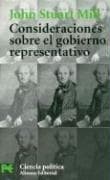
Considerations on Representative GovernmentMill, John Stuart
PhilosophyPhilosophy
Considerations on Representative Government
Mill, John Stuart
Representative government and representation
There are, no doubt, in all countries, really contented characters,
who not merely do not seek, but do not desire, what they do not
already possess, and these naturally bear no ill-will towards such as
have apparently a more favored lot. But the great mass of seeming
contentment is real discontent, combined with indolence or
self-indulgence, which, while taking no legitimate means of raising
itself, delights in bringing others down to its own level. And if we
look narrowly even at the cases of innocent contentment, we perceive
that they only win our admiration when the indifference is solely to
improvement in outward circumstances, and there is a striving for
perpetual advancement in spiritual worth, or at least a disinterested
zeal to benefit others. The contented man, or the contented family,
who have no ambition to make any one else happier, to promote the good
of their country or their neighborhood, or to improve themselves in
moral excellence, excite in us neither admiration nor approval. We
rightly ascribe this sort of contentment to mere unmanliness and want
of spirit. The content which we approve is an ability to do cheerfully
without what can not be had, a just appreciation of the comparative
value of different objects of desire, and a willing renunciation of
the less when incompatible with the greater. These, however, are
excellences more natural to the character, in proportion as it is
actively engaged in the attempt to improve its own or some other lot.
He who is continually measuring his energy against difficulties,
learns what are the difficulties insuperable to him, and what are
those which, though he might overcome, the success is not worth the
cost. He whose thoughts and activities are all needed for, and
habitually employed in, practicable and useful enterprises, is the
person of all others least likely to let his mind dwell with brooding
discontent upon things either not worth attaining, or which are not so
to him. Thus the active, self-helping character is not only
intrinsically the best, but is the likeliest to acquire all that is
really excellent or desirable in the opposite type.
Public-domain text, read in full here on John Shaqi.
Reviews
Reviews
No reviews yet
Be the first to share your thoughts on this work.
Join the Discussion
Join the discussion
Sign in to leave a comment or review.
Sign InorCreate an account