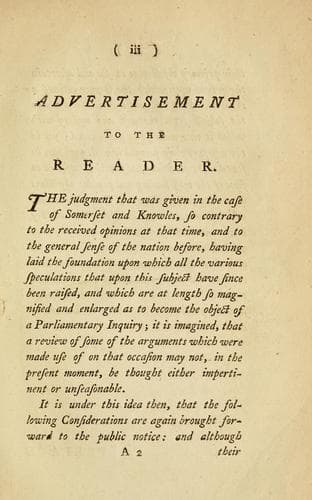
Considerations on the Negroe cause commonly so called: Addressed to the Right Honourable Lord Mansfield, lord chief justice of the Court of King's Bench, &c.Estwick, Samuel
Philosophy
Considerations on the Negroe cause commonly so called: Addressed to the Right Honourable Lord Mansfield, lord chief justice of the Court of King's Bench, &c.
Estwick, Samuel
Slavery -- Law and legislation -- Great Britain; Slavery -- Legal status, laws, etc. -- Great Britain
The great Mr. Locke says[14], that reason is supposed to make the
characteristic difference between man and beasts: but, what is the
characteristic that distinguishes man from man? That there may and
should be such a distinction, I have already endeavoured to shew; and
I am apt to think that this is a question not without its answer.
The learned Dr. Hutchinson[15] has demonstrated the existence of
_a moral sense_ in, and peculiar to, human nature; which as it
serves essentially to distinguish man from beasts, and to raise him
from the tenth to the ten thousandth link of the chain, so is it,
in my humble apprehension, an evident criterion of the specific
difference between man and man. Now Mr. Locke, speaking of reason as
that faculty whereby man is distinguished from beasts, says, that
beasts have reason in common with men; in which however he is to be
understood, that beasts possess the faculty, and in some measure
have the use, of reason; but man’s superiority over beasts consists
in the power of exerting that faculty, and in the compound ratio
of its exertion. As beasts therefore have the faculty of reason,
and it is the exertion in degree of that faculty (particularly in
obtaining abstract ideas) that creates the great difference between
man and beasts: so by the same parity of reasoning, the _moral sense_
being a faculty of the human mind common to all men, the capacity of
perceiving moral relations, the power of exercising that faculty,
and the compound ratio of its exercise, is that which makes the grand
difference and distinction between man and man. All nature, my Lord,
which is the art of God, is wisely fitted and adapted to that use and
purpose for which it was ordained; and the same observation is to
be made even in the art of man. A flea is not less perfect than an
elephant because of its size: neither is the cup that holds a pint
less compleat than the vessel that contains an hundred gallons; when
both are full, the end for which both were designed is answered and
fulfilled. The use then to be made of this doctrine, my Lord, is,
that as experience, observation, and experiment, are the foundations
upon which all speculative philosophy is raised; so, from experience
and observation, I judge that the truth of this hypothesis may be
very clearly proved and demonstrated. Now, in order to this, it is
necessary to have recourse to the histories of nations: to read, to
examine, and compare them, one with the other. To observe the moral
improvements had by them, to remark the social virtues that prevail;
and this will bring me to the accounts that have been given of
Negroes (for histories they have none of their own) and consequently
back to the subject of this address to your Lordship. But, my Lord,
forbearing to trouble your Lordship with a detail of these accounts,
I shall, referring them to your Lordship’s memory, content myself
with the bare mention of a few facts only[16].
Public-domain text, read in full here on John Shaqi.
Reviews
Reviews
No reviews yet
Be the first to share your thoughts on this work.
Join the Discussion
Join the discussion
Sign in to leave a comment or review.
Sign InorCreate an account