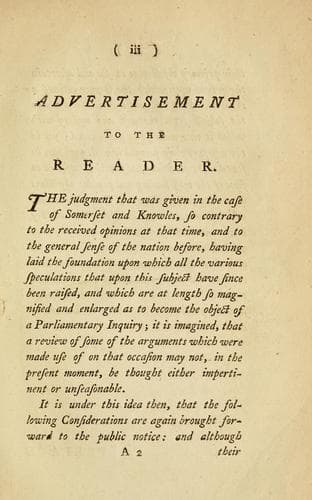
Considerations on the Negroe cause commonly so called: Addressed to the Right Honourable Lord Mansfield, lord chief justice of the Court of King's Bench, &c.Estwick, Samuel
Philosophy
Considerations on the Negroe cause commonly so called: Addressed to the Right Honourable Lord Mansfield, lord chief justice of the Court of King's Bench, &c.
Estwick, Samuel
Slavery -- Law and legislation -- Great Britain; Slavery -- Legal status, laws, etc. -- Great Britain
_Note_, Although this argument of Mr. Hargrave is said to have been
delivered in the particular Case of Somerset _a Negroe_, yet it is
meant and intended as a course of reasoning upon the general question
of the state and condition _of Negroes_.
[2] It is said in Mr. Hargrave’s argument, p. 23. “such was the
expiring state of domestic slavery in Europe at the commencement of
the 16th century, when the discovery of America and of the Western
and Eastern coasts of Africa, gave occasion to the introduction of
a new species of slavery.” If the arguer had said _a new species
of traffic_, instead of a new species of slavery, he had expressed
the real matter of fact; seeing that the law by which this concern
is regulated, considers it in no other light or view whatever. For
this reason too, it cannot be enumerated among the several species
of slavery that he has mentioned, and taken notice of; each distinct
species having its distinct laws, appropriated thereto distinctly,
as the laws of slavery. Among the Portuguese and Spaniards, I have
been given to understand, that Negroes are, and have ever been
considered, as with the English, matter of Property, and articles
of commerce in the common course of traffic; and were so estimated
by the French, until the refined age of Lewis XIV. gave rise to a
new institution of law, under the title of the _Code noir_, for the
particular government of Negroes in their American colonies. It were
to be wished that a fit and proper digest of this sort could take
place with us: but, I fear, the difficulty (which arises not so much
from the subject, as from the means of introduction) will prevent the
execution of any such plan. From the unlimited power of the Crown of
France, when laws are made, it is easy to enforce an obedience to
them: from the limited power of our monarchy, such obedience is not
to be exacted. Each English colony has a legislature of its own; and
although they all agree in the framing of laws not repugnant to the
laws of England, yet they all widely differ among themselves in the
mode and practice of those laws.
Public-domain text, read in full here on John Shaqi.
Reviews
Reviews
No reviews yet
Be the first to share your thoughts on this work.
Join the Discussion
Join the discussion
Sign in to leave a comment or review.
Sign InorCreate an account