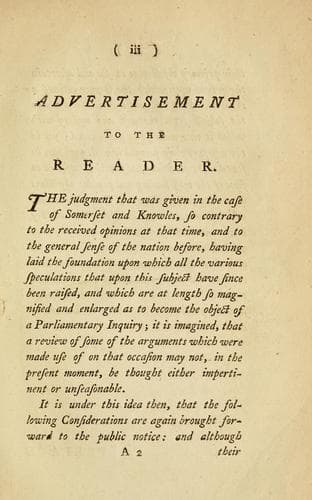
Considerations on the Negroe cause commonly so called: Addressed to the Right Honourable Lord Mansfield, lord chief justice of the Court of King's Bench, &c. — John Shaqi
Considerations on the Negroe cause commonly so called: Addressed to the Right Honourable Lord Mansfield, lord chief justice of the Court of King's Bench, &c.Estwick, Samuel
Philosophy
Considerations on the Negroe cause commonly so called: Addressed to the Right Honourable Lord Mansfield, lord chief justice of the Court of King's Bench, &c.
Estwick, Samuel
Slavery -- Law and legislation -- Great Britain; Slavery -- Legal status, laws, etc. -- Great Britain
country or age be traced back to any other source. Immemorial usage
preserves the memory of positive law long after all traces of the
occasion, reason, authority, and time of its introduction, are lost;
and in a Case so odious as the condition of slaves must be, taken
strictly, the power claimed by this return was never in use here:
no master ever was allowed here to take a slave by force to be sold
abroad because he had deserted from his service, or for any other
reason whatever; we cannot say, _the Cause set forth by this return_
is allowed or approved of by the laws of this kingdom, and therefore
the man must be discharged.”
I must confess, I have been greatly puzzled in endeavouring
to reconcile this judgment with this state of it, and with my
comprehension.
“We pay due attention to the opinion of Sir Philip York and Mr.
Talbot,” are the words of the Noble Lord who delivered the judgment
of the Court; and yet the judgment is, in operation and effect,
directly subversive of the opinion. Now I must take for granted that
this opinion would not have been cited, especially in so affirmative
a manner, if it had had nothing at all to do with the Case then
before the Court: because such citation would have been unmeaning
and unnecessary. This being admitted, it follows, that the law laid
down in this opinion was either the law of the Case, or it was not.
If it were the law of the Case, the judgment would have been governed
by that law, and consequently contrary to what it is. If it were
not the law of the Case, in order to shew what the law is, and that
the law and the judgment might correspond with each other, as cause
and effect, it would seem, _ex necessitate rei_, that the doctrine
advanced in this opinion should have been set aside by the superior
force of legal argumentation and authority. But the reasoning upon
the judgment stands thus: In the Premises this opinion is cited as
authority; then, without any middle term denying that authority, the
conclusion is, by the judgment, that it is no authority at all. Under
these problematical circumstances the only solution possible to me
was, that there might be two decisions intentionally contained under
one judgment: that is to say, that the opinion of Sir Philip York
and Mr. Talbot, was the law upon the general merits of the question;
and that this judgment of the Court was the law upon this particular
state of it. Thus for instance: if the return made to the writ of
Habeas Corpus in this Case had denied the lawfulness of the writ
itself, and Mr. Steuart had claimed Somerset upon the ground only
of being his commercial _property_; then the opinion of Sir Philip
York and Mr. Talbot had operated as law and authority: but as the
return had admitted the right of slavery, and Mr. Steuart had claimed
Somerset as his slave, there being no laws of slavery now _in use_
in this country, either for Negroes, or for any other species of the
human being, the judgment of the court was, _from the insufficiency
Public-domain text, read in full here on John Shaqi.
Reviews
Reviews
No reviews yet
Be the first to share your thoughts on this work.
Join the Discussion
Join the discussion
Sign in to leave a comment or review.
Sign InorCreate an account