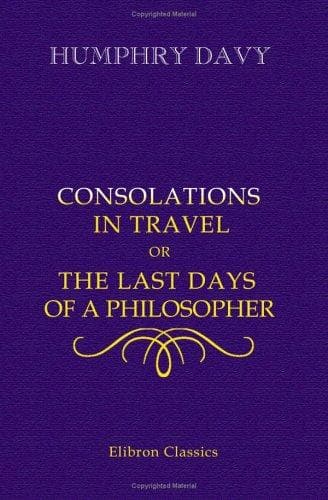
Consolations in Travel; or, the Last Days of a PhilosopherDavy, Humphry, Sir
Philosophy
Consolations in Travel; or, the Last Days of a Philosopher
Davy, Humphry, Sir
Chemists -- Great Britain -- Biography; Davy, Humphry, Sir, 1778-1829
and a wayward and disobedient child who reasons upon and doubts the
utility of the discipline of such a father is much in the same state in
which the adult man is who doubts if there be good in the decrees of
Providence and who questions the harmony of the plan of the moral
universe.
_Onu_.--Allowing the perfection of your moral scheme of religion and its
fitness for the nature of man, I find it impossible to believe the
primary doctrines on which this scheme is founded. You make the Divine
Mind, the creator of infinite worlds, enter into the form of a man born
of a virgin, you make the eternal and immortal God the victim of shameful
punishment and suffering death on the cross, recovering His life after
three days, and carrying His maimed and lacerated body into the heaven of
heavens.
_Amb_.--You, like all other sceptics, make your own interpretations of
the Scriptures and set up a standard for divine power in human reason.
The infinite and eternal mind, as I said before, fits the doctrines of
religion to the minds by which they are to be embraced. I see no
improbability in the idea that an integrant part of His essence may have
animated a human form; there can be no doubt that this belief has existed
in the human mind, and the belief constitutes the vital part of the
religion. We know nothing of the generation of the human being in the
ordinary course of nature; how absurd then to attempt to reason upon the
acts of the Divine Mind! nor is there more difficulty in imagining the
event of a divine conception than of a divine creation. To God the
infinite, little and great, as measured by human powers, are equal; a
creature of this earth, however humble and insignificant, may have the
same weight with millions of superior beings inhabiting higher systems.
But I consider all the miraculous parts of our religion as effected by
changes in the sensations or ideas of the human mind, and not by physical
changes in the order of nature; a man who has to repair a piece of
machinery, as a clock, must take it to pieces, and, in fact, re-make it,
but to infinite wisdom and power a change in the intellectual state of
the human being may be the result of a momentary will, and the mere act
of faith may produce the change. How great the powers of imagination
are, even in ordinary life, is shown by many striking facts, and nothing
seems impossible to this imagination when acted upon by divine influence.
To attempt to answer all the objections which may be derived from the
want of conformity in the doctrines of Christianity to the usual order of
events would be an interminable labour. My first principle is, that
religion has nothing to do with the common order of events; it is a pure
and divine instinct intended to give results to man which he cannot
obtain by the common use of his reason, and which at first view often
appear contradictory to it, but which when examined by the most refined
Public-domain text, read in full here on John Shaqi.
Reviews
Reviews
No reviews yet
Be the first to share your thoughts on this work.
Join the Discussion
Join the discussion
Sign in to leave a comment or review.
Sign InorCreate an account