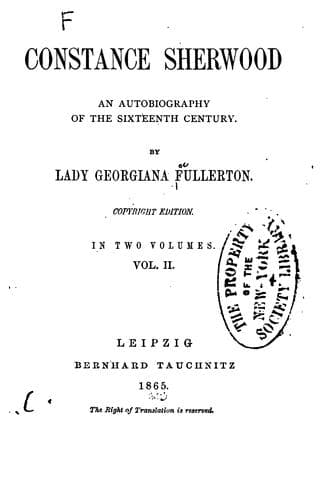
Constance Sherwood: An Autobiography of the Sixteenth CenturyFullerton, Georgiana
History
Constance Sherwood: An Autobiography of the Sixteenth Century
Fullerton, Georgiana
Great Britain -- History -- Elizabeth, 1558-1603 -- Fiction
made me read a portion of that most fine and sweet poem on the
delivery of the holy city Jerusalem, composed by Signor Torquato
Tasso, a gentleman who resided at that time at the court of the Duke
of Ferrara, and which one Mr. Fairfax has since done into English
verse. The first four cantos thereof were given to Mr. Wells by a
young gentleman, who had for a while studied at the University of
Padua. This fair poem, and mostly the second book thereof, hath
remained imprinted in my memory with a singular fixity, by reason that
it proved the occasion of my discerning for the first time a special
inclination on Hubert's side toward myself, who thought nothing of
love, but was only glad to have acquired a friend endowed with so much
wit and superior knowledge, and willing to impart it. This book, I
say, did contain a narration which bred in me so great a resentment of
the author's merits, and so quick a sympathy with the feigned subjects
of his muse, that never before or since methinks has a fiction so
moved me as the story of Olindo and Sophronisba.
Methinks this was partly ascribable to a certain likeness between the
scenes described by the poet and some which take place at this time in
our country. In the maiden of high and noble thoughts, fair, but
heedless of her beauty, who stood in the presence of the soldan, once
a Christian, then a renegade, taking on herself the sole guilt,--O
virtuous guilt! O worthy crime!--of which all the Christians were
accused, to wit, of rescuing sacred Mary's image from the hands of the
infidels who did curse and blaspheme it, and, when all were to die for
the act of one unknown, offered herself a ransom for all, and with a
shamefaced courage, such as became a maid, and a bold modesty
befitting a saint--a bosom moved indeed, but not dismayed, a fair but
not pallid cheek--was content to perish for that the rest should
live;--in her, I say, I saw a likeness in spirit to those who suffer
nowadays for a like faith with hers, not at the hands of infidels, but
of such whose parents did for the most part hold that same belief
which they do now make out to be treason.
Hubert, observing me to be thus moved, smiled, and asked if, in the
like case, I should have willed to die as Sophronisba.
"Yes," I answered, "if God did give me grace;" and then, as I uttered
the words, I thought it should not be lawful to tell a lie, not for to
save all the lives in the world; which doubt I imparted to him, who
laughed and said he was of the poet's mind, who doth exclaim, touching
this lie, "O noble deceit! worthier than truth itself!" and that he
thought a soul should not suffer long in purgatory for such a sin.
"Maybe not," I answered; "yet, I ween, there should be more faith in a
sole commitment to God of the events than in doing the least evil so
that good should come of it."
He said, "I marvel, Mistress Constance, what should be your thoughts
thereon if the life of a priest was in your hands, and you able to
save him by a lie."
Public-domain text, read in full here on John Shaqi.
Reviews
Reviews
No reviews yet
Be the first to share your thoughts on this work.
Elsewhere in the archive
Join the Discussion
Join the discussion
Sign in to leave a comment or review.
Sign InorCreate an account